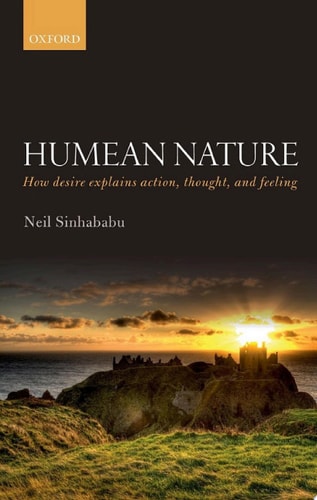
Humean Nature: How Desire Explains Action, Thought, and Feeling
0
0
As an Amazon Associate and affiliate partner, Menrva Books earns from qualifying purchases. Learn more
Author Description
Neil Sinhababu defends the Humean Theory of Motivation, according to which desire drives all human action and practical reasoning. Desire motivates us to pursue its object, makes thoughts of its object pleasant or unpleasant, focuses attention on its object, and is amplified by vivid representations of its object. These aspects of desire explain a vast range of psychological phenomena - why motivation often accompanies moral belief, how intentions shape our planning, how we exercise willpower, what it is to be a human self, how we express our emotions in action, why we procrastinate, and what we daydream about. Some philosophers regard such phenomena as troublesome for the Humean Theory, but the properties of desire help Humeans provide simpler and better explanations of these phenomena than their opponents can. The success of the Humean Theory in explaining a wide range of folk-psychological and experimental data, including those that its opponents cite in counterexamples, suggest that it is true. And the Humean Theory has revolutionary consequences for ethics, suggesting that moral judgments are beliefs about what feelings like guilt, admiration, and hope accurately represent in objective reality.
Menrva's Summary
THE THESIS
Does desire serve as the fundamental driver for all human action, thought, and practical reasoning? Neil Sinhababu, a philosopher specializing in ethics and the philosophy of mind, defends the Humean Theory of Motivation against contemporary critiques. He argues that desire is not merely a passive state but an active force that directs attention, influences cognition, and shapes the architecture of the human self. By synthesizing folk-psychological observations with experimental data, the author posits that desire provides a more parsimonious and accurate explanation for human behavior than competing theories.
THE SCOPE MAP
What You Will Find
- A comprehensive defense of the Humean Theory of Motivation.
- Analysis of how desire influences willpower, procrastination, and daydreaming.
- A framework connecting moral belief to motivational states.
- An exploration of the relationship between desire and emotional expression.
Scope Limits
- The text focuses primarily on the Humean perspective and does not provide an exhaustive survey of all non-Humean theories of motivation.
- The work is limited to philosophical and psychological inquiry rather than clinical or therapeutic application.
THE AUTHORITY PERSPECTIVE
Scholars and philosophers frequently note the rigorous analytical density of the prose, which is intended for an academic audience familiar with meta-ethics. Experts highlight this work as a significant contribution to the ongoing debate regarding the nature of motivation and the structure of moral judgment.
Page Count:
224
Publication Date:
2017-01-01
Publisher:
OUP Oxford
ISBN-10:
0191086479
ISBN-13:
9780191086472
Psychology
Philosophy
Human beings
Metaphysics
Ethics
Community Tags
Similar Books