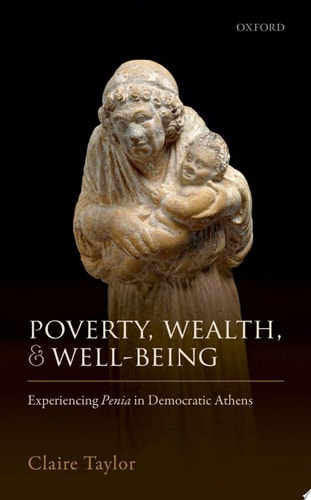
Poverty, Wealth, and Well-being
0
0
As an Amazon Associate and affiliate partner, Menrva Books earns from qualifying purchases. Learn more
Author Description
Poverty in fifth- and fourth-century BCE Athens was a markedly different concept to that with which we are familiar today. Reflecting contemporary ideas about labour, leisure, and good citizenship, the 'poor' were considered to be not only those who were destitute, or those who were living at the borders of subsistence, but also those who were moderately well-off but had to work for a living. Defined in this way, this group covered around 99 per cent of the population of Athens. This conception of penia (poverty) was also ideologically charged: the poor were contrasted with the rich and found, for the most part, to be both materially and morally deficient. Poverty, Wealth, and Well-being sets out to rethink what it meant to be poor in a world where this was understood as the need to work for a living, exploring the discourses that constructed poverty as something to fear and linking them with experiences of penia among different social groups in Athens. Drawing on current research into and debates around poverty within the social sciences, it provides a critical reassessment of poverty in democratic Athens and argues that it need not necessarily be seen in terms of these elitist ideological categories, nor indeed solely as an economic condition (the state of having no wealth), but that it should also be understood in terms of social relations, capabilities, and well-being. In developing a framework to analyse the complexities of poverty so conceived and exploring the discourses that shaped it, the volume reframes poverty as being dynamic and multidimensional, and provides a valuable insight into what the poor in Athens - men and women, citizen and non-citizen, slave and free - were able to do or to be.
Menrva's Summary
THE THESIS
This book investigates how the Athenian concept of 'penia'—or poverty—functioned as a complex social and ideological construct rather than a simple economic state of destitution. Claire Taylor, a scholar of ancient history, utilizes contemporary social science frameworks to challenge traditional elitist definitions of poverty in democratic Athens. By analyzing the intersection of labor, citizenship, and moral status, the author argues that poverty should be understood through the lens of social relations, individual capabilities, and overall well-being.
THE SCOPE MAP
What You Will Find
- Analysis of the Athenian discourse on labor, leisure, and citizenship during the 5th and 4th centuries BCE.
- A multidimensional framework for evaluating poverty based on social relations and capabilities.
- Examination of diverse social groups including citizens, non-citizens, and enslaved individuals.
Scope Limits
- The analysis is geographically restricted to the city-state of Athens.
- The study does not provide a comprehensive economic history of all Mediterranean trade networks during this period.
THE AUTHORITY PERSPECTIVE
Scholars recognize this work as a significant contribution to the social history of the classical world, particularly for its application of modern sociological theory to ancient texts. Readers frequently note the academic density of the prose, which is intended for students and researchers of classical history and social theory.
Page Count:
352
Publication Date:
2017-01-01
Publisher:
Oxford University Press
ISBN-10:
019109062X
ISBN-13:
9780191090622
Economics
History
Sociology
Ancient Greece
Social History
Community Tags
Similar Books