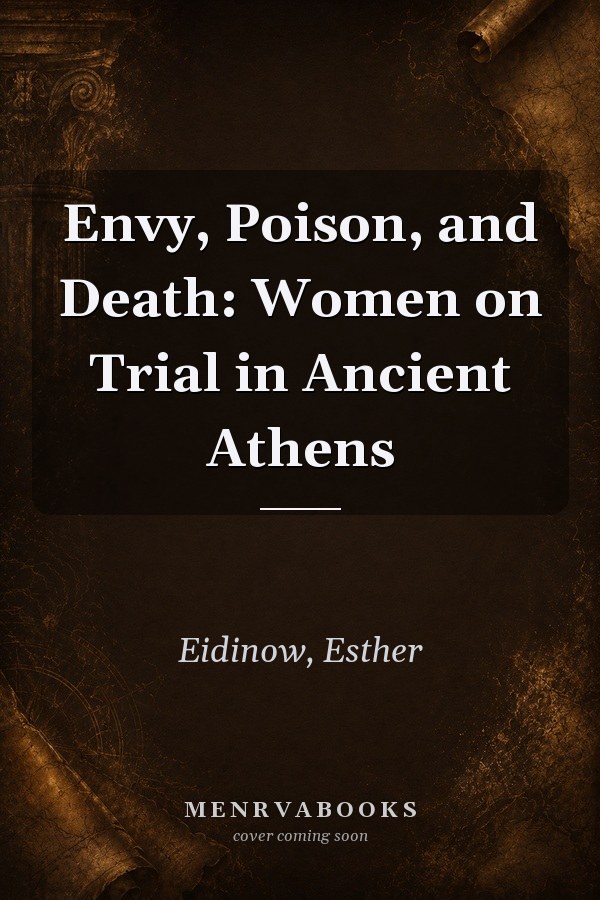
Envy, Poison, and Death: Women on Trial in Ancient Athens
0
0
As an Amazon Associate and affiliate partner, Menrva Books earns from qualifying purchases. Learn more
Author Description
At the heart of this volume are three trials held in Athens in the fourth century BCE. The defendants were all women and in each case the charges involved a combination of ritual activities. Two were condemned to death. Because of the brevity of the ancient sources, and their lack of agreement, the precise charges are unclear, and the reasons for taking these women to court remain mysterious. 'Envy, Poison, and Death' takes the complexity and confusion of the evidence not as a riddle to be solved, but as revealing multiple social dynamics. It explores the changing factors - material, ideological, and psychological - that may have provoked these events. It focuses in particular on the dual role of envy (phthonos) and gossip as processes by which communities identified people and activities that were dangerous, and examines how and why those local, even individual, dynamics may have come to shape official civic decisions during a time of perceived hardship. At first sight so puzzling, these trials reveal a vivid picture of the socio-political environment of Athens during the early-mid fourth century BCE, including responses to changes in women's status and behaviour, and attitudes to ritual activities within the city. The volume reveals some of the characters, events, and even emotions that would help to shape an emergent concept of magic: it suggests that the boundary of acceptable behaviour was shifting, not only within the legal arena but also through the active involvement of society beyond the courts.
Menrva's Summary
THE THESIS
This volume investigates the socio-political motivations behind the prosecution of three women in fourth-century BCE Athens, questioning how ritual activities and social anxieties intersected within the legal system. Esther Eidinow, a scholar of ancient Greek history and magic, utilizes the fragmented and often contradictory ancient sources to construct a framework that prioritizes social dynamics over a singular historical solution. By analyzing the interplay between envy, gossip, and civic decision-making, the author argues that these trials reflect a broader shift in the Athenian perception of acceptable behavior and the emergence of a distinct concept of magic.
THE SCOPE MAP
What You Will Find
- Analysis of three specific legal cases involving women in fourth-century BCE Athens.
- Examination of the role of phthonos (envy) and gossip as mechanisms of social control.
- Investigation into the shifting status of women and attitudes toward ritual practices.
- Contextualization of Athenian civic responses during periods of perceived hardship.
Scope Limits
- The text does not provide definitive biographical details for the defendants due to the scarcity of primary sources.
- It does not attempt to reconstruct the exact legal proceedings of the trials, focusing instead on the social environment surrounding them.
THE AUTHORITY PERSPECTIVE
Scholars and historians frequently cite this work for its nuanced approach to the limitations of ancient evidence and its focus on the sociology of Athenian law. Readers often note the academic rigor of the prose, which provides a sophisticated look at how local community dynamics influenced formal civic outcomes.
Page Count:
421
Publication Date:
2016-01-01
Publisher:
Oxford University Press
ISBN-10:
0191747300
ISBN-13:
9780191747304
History
Ancient Greece
Legal History
Gender Studies
Social History
Community Tags
Similar Books