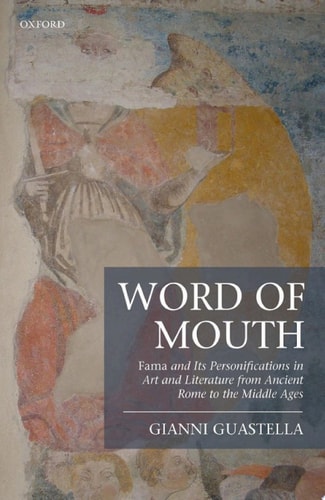
Word of Mouth: Fama and Its Personifications in Art and Literature from Ancient Rome to the Middle Ages
0
0
As an Amazon Associate and affiliate partner, Menrva Books earns from qualifying purchases. Learn more
Author Description
The concept expressed by the Roman term fama, although strictly linked to the activity of speaking, recalls a more complex form of collective communication that puts diverse information and opinions into circulation by 'word of mouth', covering the spreading of rumours, expression of common anxieties, and sharing of opinions about peers, contemporaries, or long-dead personages within both small and large communities of people. This 'hearsay' method of information propagation, of chain-like transmission across a complex network of transfers of uncertain order and origin, often rapid and elusive, has been described by some ancient writers as like the flight of a winged word, provoking interesting contrasts with more recent theories that anthropologists and sociologists have produced about the same phenomenon. This volume proceeds from a brief discussion of the ancient concept to a detailed examination of the way in which fama has been personified in ancient and medieval literature and in European figurative art between the end of the fourteenth and the beginning of the sixteenth centuries. Commenting on examples ranging from Virgil's Fama in Book 4 of the Aeneid to Chaucer's House of Fame, it addresses areas of anthropological, sociological, literary, and historical-artistic interest, charting the evolving depiction of fama from a truly interdisciplinary perspective. Following this theme, it is revealed that although the most important personifications were originally created to represent the invisible but pervasive diffusion of talk which circulates information about others, these then began to give way to embodiments of the abstract idea of the glory of illustrious men. By the end of the medieval period, these two different representations, of rumour and glory, were variously combined to create the modern icon of Fame with which we are more familiar today.
Menrva's Summary
THE THESIS
This volume investigates the evolution of the Roman concept of 'fama' as both a mechanism of collective communication and a personified figure in literature and art from antiquity through the Middle Ages. Gianni Guastella, a scholar of classical literature, examines how the ancient understanding of 'word of mouth'—a rapid, elusive, and often unreliable transmission of information—transformed over centuries. By analyzing primary texts and visual representations, the author argues that the personification of fama shifted from representing the pervasive diffusion of rumor to embodying the abstract concept of individual glory.
THE SCOPE MAP
What You Will Find
- Analysis of the Roman concept of fama as a social communication network.
- Examination of literary depictions ranging from Virgil’s Aeneid to Chaucer’s House of Fame.
- Study of European figurative art between the late fourteenth and early sixteenth centuries.
- Interdisciplinary synthesis of anthropological, sociological, and historical-artistic perspectives.
Scope Limits
- The study focuses primarily on Western European traditions and does not cover non-Western concepts of rumor or fame.
- The analysis of figurative art is constrained to the specific period between the late fourteenth and early sixteenth centuries.
THE AUTHORITY PERSPECTIVE
Experts recognize this work as a rigorous interdisciplinary study that successfully bridges classical philology with art history and social theory. Readers frequently note the academic density of the prose, which provides a comprehensive framework for understanding the cultural transition from rumor to institutionalized fame.
Page Count:
456
Publication Date:
2017-01-01
Publisher:
OUP Oxford
ISBN-10:
0191090328
ISBN-13:
9780191090325
History
Art History
English
English & College Success
Art medieval
Criticism history
Anthropology
Sociology
Literary Criticism
Community Tags
Similar Books