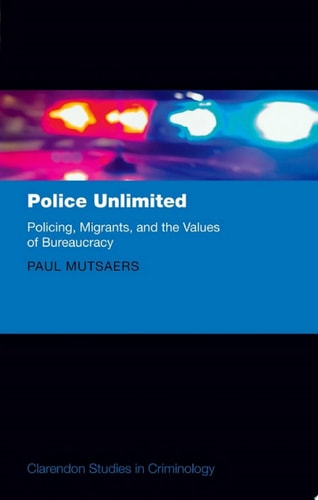
Police Unlimited
0
0
As an Amazon Associate and affiliate partner, Menrva Books earns from qualifying purchases. Learn more
Author Description
Police Unlimited is centred on the controversial idea that police forces are a focal point for conflict in modern society. Instead of emphasising the socially integrative function of police forces, the book links to a conflict model concerned with its socially divisive effects. Throughout the book, the consequences of this social division are discussed, using a detailed ethnographic study of the Dutch police as a starting point, and extending the analysis out to look at the global situation. The book is based on a five year ethnography exploring police discrimination in the Dutch police. It examines cases of conflict, both inside and outside the police station, thus covering interethnic tensions at work as well as hostility towards migrants observed while joining officers on patrol. The cases are discussed in light of the corroding public character of Dutch policing and the risks involved in terms of discrimination, and the arbitrary, or even privatized, use of power. Signalling an increased blurring of the private and public spheres in policing, the book warns of an "unlimited" police service that is no longer constrained by the public contours that delineate a legal bureaucracy. To develop a police anthropology, the ethnographic materials are consistently compared with other police ethnographies in the "global north" and "global south". This comparative analysis points out that the demise of bureaucracy makes it increasingly difficult for police organizations across the globe to exclude politics, particularism and populism from their operations. Police Unlimited addresses the curious position of police organizations in the 21st century through the lens of a police anthropology concerned with deep-seated police discrimination across the world. In an age in which bureaucracy is considered to be the social evil of our time, Police Unlimited offers a controversial message: it is exactly the dehumanized and impersonal nature of bureaucracy that transforms policing into
Menrva's Summary
THE THESIS
This book investigates whether the erosion of traditional bureaucratic structures in modern police forces has transformed them into agents of social division and political instability. Paul Mutsaers, an expert in police anthropology, utilizes a five-year ethnographic study of the Dutch police to argue that the decline of impersonal, rule-bound bureaucracy allows for the encroachment of populism, particularism, and discriminatory practices. By comparing these findings with global policing trends, the author posits that the blurring of public and private spheres creates an 'unlimited' police force that operates outside established legal constraints.
THE SCOPE MAP
What You Will Find
- A longitudinal ethnographic study of the Dutch police force.
- Comparative analysis of police practices in the 'global north' and 'global south'.
- Theoretical framework for a new 'police anthropology'.
- Examination of interethnic tensions and discriminatory behaviors within law enforcement.
Scope Limits
- The study does not provide a comprehensive history of global policing models.
- It does not offer specific policy recommendations for reforming police bureaucracy.
THE AUTHORITY PERSPECTIVE
Scholars in the field of criminology frequently cite this work for its rigorous ethnographic methodology and its critical stance on the privatization of police power. Readers often note the academic density of the prose, which serves as a foundational text for those studying the intersection of police culture and social conflict.
Page Count:
224
Publication Date:
2019-01-01
Publisher:
OUP Oxford
ISBN-10:
0191092797
ISBN-13:
9780191092794
Anthropology
Humanities - Music - Ethnic
Hip-hop
Social Studies
Humanities - Music - Ethnomusicology
Ethnic
Law Enforcement
Sociology
Criminology
Community Tags
Other Editions(2)
Similar Books


Reader Comments
Share Your Thoughts
No comments yet. Be the first to share your thoughts!