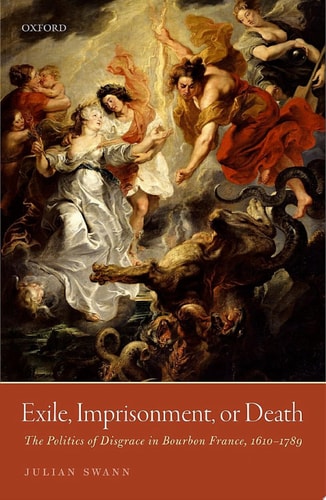
Exile, Imprisonment, or Death: The Politics of Disgrace in Bourbon France, 1610-1789
0
0
As an Amazon Associate and affiliate partner, Menrva Books earns from qualifying purchases. Learn more
Author Description
On the accession of Louis XIII in 1610 following the assassination of his father, the Bourbon dynasty stood on unstable foundations. For all of Henri IV's undoubted achievements, he had left his son a realm that was still prey to the ambitions of an aristocracy that possessed independent military force and was prepared to resort to violence and vendetta in order to defend its interests and honour. To establish his personal authority, Louis XIII was forced to resort to conspiracy and murder, and even then his authority was constantly challenged. Yet a little over a century later, as the reign of Louis XIV drew to a close, such disobedience was impossible. Instead, a simple royal command expressing the sovereign's disgrace was sufficient to compel the most powerful men and women in the kingdom to submit to imprisonment or internal exile without a trial or an opportunity to justify their conduct, abandoning their normal lives, leaving families, careers, offices, and possessions behind in obedience to their sovereign. To explain that transformation, this volume examines the development of this new 'politics of disgrace', why it emerged, how it was conceptualised, the conventions that governed its use, and reactions to it, not only from the perspective of the monarch and his noble subjects, but also the great corporations of the realm and the wider public. Although that new model of disgrace proved remarkably successful, influencing the ideas and actions of the dominant social elites, it was nevertheless contested, and the critique of disgrace connects to the second aim of this work, which is to use shifting attitudes to the practice as a means of investigating the nature of Old Regime political culture and some of the dramatic and profound changes it experienced in the years separating Louis XIII's dramatic seizure of power from the French Revolution.
Menrva's Summary
THE THESIS
This volume investigates how the French monarchy transformed the practice of disgrace into a potent political instrument to consolidate absolute power between 1610 and 1789. Julian Swann, a specialist in early modern French history, analyzes the shift from an era of aristocratic rebellion and violence to one where royal command alone could force elites into exile or imprisonment. By examining the conceptualization and application of this 'politics of disgrace,' the author argues that this practice was central to the evolution of political culture in the Old Regime.
THE SCOPE MAP
What You Will Find
- Analysis of the transition from aristocratic military independence to royal absolutism.
- Examination of the conventions and legal frameworks governing royal disgrace.
- Perspectives from the monarch, the nobility, major state corporations, and the broader public.
Scope Limits
- The study focuses specifically on the Bourbon monarchy and does not extend beyond the onset of the French Revolution.
- The work does not provide a comprehensive biography of individual monarchs but focuses on the political mechanism of disgrace.
THE AUTHORITY PERSPECTIVE
Historians recognize this work as a significant contribution to the study of French political culture and the mechanics of power under the Bourbons. Scholars frequently note the meticulous archival research and the clarity with which Swann connects individual political fates to broader shifts in state authority.
Page Count:
545
Publication Date:
2016-01-01
Publisher:
OUP Oxford
ISBN-10:
0191093025
ISBN-13:
9780191093029
History
History - Modern
European History
France history
Monarchy
French History
Community Tags
Other Editions(2)
Similar Books




Reader Comments
Share Your Thoughts
No comments yet. Be the first to share your thoughts!