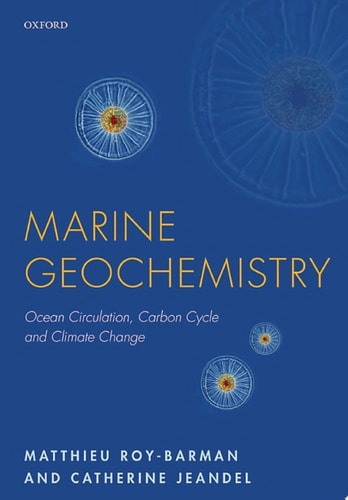
Marine Geochemistry
0
0
As an Amazon Associate and affiliate partner, Menrva Books earns from qualifying purchases. Learn more
Author Description
Marine Geochemistry Uses Chemical Elements And Their Isotopes To Study How The Ocean Works In Terms Of Ocean Circulation, Chemical Composition, Biological Activity And Atmospheric Co2 Regulation. This Rapidly Growing Field Is At A Crossroad For Many Disciplines (physical, Chemical And Biological Oceanography, Geology, Climatology, Ecology, Etc.). It Provides Important Quantitative Answers To Questions Such As: What Is The Deep Ocean Mixing Rate? How Much Atmospheric Co2 Is Pumped By The Ocean? How Fast Are Pollutants Removed From The Ocean? How Do Ecosystems React To Anthropogenic Pressure? This Text Gives A Simple Introduction To The Concepts, The Methods And The Applications Of Marine Geochemistry With A Particular Emphasis On Isotopic Tracers. Overall Introducing A Very Large Number Of Topics (physical Oceanography, Ocean Chemistry, Isotopes, Gas Exchange, Modelling, Biogeochemical Cycles), With A Balance Of Didactic And Indepth Information, It Provides An Outline And A Complete Course In Marine Geochemistry. Throughout, The Book Uses A Hands-on Approach With Worked Out Exercises And Problems (with Answers Provided At The End Of The Book), To Help The Students Work Through The Concepts Presented. A Broad Scale Approach Is Take Including Ocean Physics, Marine Biology, Ocean-climate Relations, Remote Sensing, Pollutions And Ecology, So That The Reader Acquires A Global Perspective Of The Ocean. It Also Includes New Topics Arising From Ongoing Research Programs. This Textbook Is Essential Reading For Students, Scholars, Researchers And Other Professionals.
Menrva's Summary
THE THESIS
This text investigates the fundamental chemical processes of the ocean and how isotopic tracers can be used to quantify complex marine phenomena. Authors Catherine Jeandel and Matthieu Roy-Barman provide a comprehensive academic framework that integrates physical, chemical, and biological oceanography. By utilizing quantitative data and geochemical principles, the authors explain how the ocean regulates atmospheric CO2 and responds to anthropogenic pressures.
THE SCOPE MAP
What You Will Find
- Principles of ocean circulation and chemical composition
- Methodology for using isotopic tracers in marine research
- Analysis of gas exchange and biogeochemical cycles
- Worked-out exercises and problems with provided solutions
Scope Limits
- Does not provide an exhaustive history of oceanographic exploration
- Focuses primarily on geochemical and isotopic applications rather than purely biological taxonomy
THE AUTHORITY PERSPECTIVE
Experts identify this text as a structured, didactic resource suitable for students and researchers seeking a global perspective on marine systems. Readers frequently note the balance between theoretical concepts and practical application through the inclusion of problem sets.
Page Count:
384
Publication Date:
2016-01-01
Publisher:
Oxford University Press
ISBN-10:
0191091413
ISBN-13:
9780191091414
Science
Geology
Oceanography
Geochemistry
Climatology
Community Tags
Similar Books