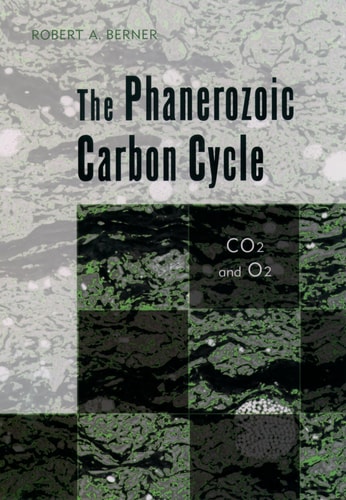
The Phanerozoic Carbon Cycle: CO2 and O2
0
0
As an Amazon Associate and affiliate partner, Menrva Books earns from qualifying purchases. Learn more
Author Description
The term "carbon cycle" is normally thought to mean those processes that govern the present-day transfer of carbon between life, the atmosphere, and the oceans. This book describes another carbon cycle, one which operates over millions of years and involves the transfer of carbon between rocks and the combination of life, the atmosphere, and the oceans. The weathering of silicate and carbonate rocks and ancient sedimentary organic matter (including recent, large-scale human-induced burning of fossil fuels), the burial of organic matter and carbonate minerals in sediments, and volcanic degassing of carbon dioxide contribute to this cycle. In The Phanerozoic Carbon Cycle, Robert Berner shows how carbon cycle models can be used to calculate levels of atmospheric CO2 and O2 over Phanerozoic time, the past 550 million years, and how results compare with independent methods. His analysis has implications for such disparate subjects as the evolution of land plants, the presence of giant ancient insects, the role of tectonics in paleoclimate, and the current debate over global warming and greenhouse gases.
Menrva's Summary
THE THESIS
This book investigates the long-term geochemical processes that regulate atmospheric carbon dioxide and oxygen levels over the past 550 million years. Robert A. Berner, a prominent geochemist, utilizes quantitative modeling to reconstruct the Phanerozoic carbon cycle. By integrating data on rock weathering, volcanic degassing, and organic matter burial, he provides a framework for understanding how geological shifts influence atmospheric composition and biological evolution.
THE SCOPE MAP
What You Will Find
- Quantitative models of carbon and oxygen flux over the Phanerozoic eon
- Analysis of silicate and carbonate rock weathering rates
- Correlation between atmospheric gas levels and biological phenomena like insect gigantism
- Evaluation of tectonic impacts on paleoclimate
Scope Limits
- Does not provide a comprehensive history of all biological evolution
- Focuses primarily on geochemical modeling rather than localized climate events
THE AUTHORITY PERSPECTIVE
Experts recognize this work as a foundational text for understanding deep-time geochemical cycles and their influence on the Earth's climate. Readers frequently note the technical density of the prose, which requires a strong background in geology or chemistry to fully grasp the modeling methodologies presented.
Page Count:
158
Publication Date:
2004-01-01
Publisher:
Oxford University Press
ISBN-10:
0190291613
ISBN-13:
9780190291617
Science
Earth Sciences
Geophysics
Geology
Chemistry
Earth Science