Dirty Money: On Financial Delinquency
0
0
As an Amazon Associate and affiliate partner, Menrva Books earns from qualifying purchases. Learn more
Author Description
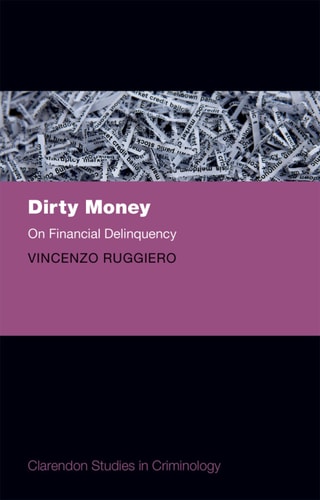
Navigating financial crashes of the Late Middle Ages up to the present day and analysing them through the lenses of classical, positivist, functionalist and Marxist criminology, Dirty Money: On Financial Delinquency explores the growth of grey areas in the financial world and our understanding, or misunderstanding, of financial delinquency. Pope Francis, while denouncing the incapacity of governments to reduce poverty and fight the exploitation of cheap labour, has also condemned greed, repeating several times the old medieval adage: money is the excrement of the devil. This distinction between clean and excremental, pure and impure, informs the symbolic order of many traditional and contemporary societies; however, it can also be used to single out criminal activity as opposed to law-abiding conduct and, in particular, to separate acceptable from unacceptable practices in the economic domain. With a focus on financial crime, whose ambiguity, ubiquity and evolving nature make the separation between acceptable and unacceptable practices inherently problematic, this book examines the process whereby the excrement of the devil was slowly 'freed' from both its sinful and criminal character. It is a study of how human action turns something seemingly benign into an instrument for the production of harm. Its focus, therefore, is on dirty money - namely the illegitimate appropriation of financial resources by individuals and groups holding expert knowledge and, often, occupying positions of power. The ideological arguments accompanying this evolution are scrutinised, alongside the history of financial initiatives and the accompanying 'crunches'. The struggle juxtaposing criminalization and decriminalization is at the core of all chapters, which analyse a series of major events chronologically, from the exploits of John Law to the deeds of contemporary finance. Analytically located in the area of white-collar crime, Dirty Money examines episodes of financial delinquency and
Menrva's Summary
THE THESIS
This book investigates the historical and sociological evolution of financial delinquency, questioning how society distinguishes between legitimate economic activity and criminal exploitation. Vincenzo Ruggiero, a professor of sociology, utilizes a multidisciplinary criminological framework to analyze how financial practices once considered sinful or criminal have been normalized over time. By examining the intersection of power, expert knowledge, and economic policy, the author argues that the boundary between acceptable and unacceptable financial conduct is a fluid, ideological construct rather than a fixed legal reality.
THE SCOPE MAP
What You Will Find
- A chronological analysis of financial crises from the Late Middle Ages to contemporary market crashes.
- Application of classical, positivist, functionalist, and Marxist criminological theories to financial behavior.
- Case studies ranging from the exploits of John Law to modern-day financial instruments.
Scope Limits
- The text does not provide a comprehensive legal manual for prosecuting current financial crimes.
- It does not focus on individual retail-level fraud, concentrating instead on institutional and systemic white-collar delinquency.
THE AUTHORITY PERSPECTIVE
Experts in criminology recognize this work as a significant contribution to the study of white-collar crime and the sociology of finance. Readers frequently note the academic density of the prose, which requires a foundational understanding of criminological theory to fully appreciate the author's arguments.
Page Count:
280
Publication Date:
2017-01-01
Publisher:
OUP Oxford
ISBN-10:
0191092770
ISBN-13:
9780191092770
History
Economics
White Collar Crime
Criminology
Sociology
Professional Career & Trade
Community Tags
Other Editions(2)
Similar Books

Reader Comments
Share Your Thoughts
No comments yet. Be the first to share your thoughts!