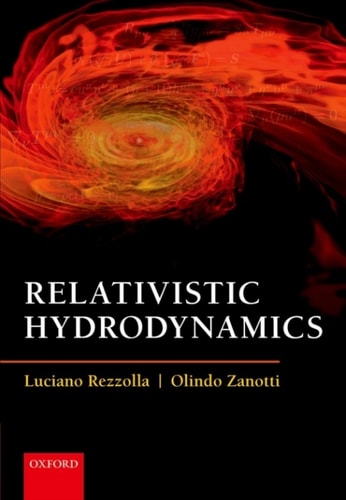
Relativistic Hydrodynamics
0
0
As an Amazon Associate and affiliate partner, Menrva Books earns from qualifying purchases. Learn more
Author Description
Relativistic hydrodynamics is a very successful theoretical framework to describe the dynamics of matter from scales as small as those of colliding elementary particles, up to the largest scales in the universe. This book provides an up-to-date, lively, and approachable introduction to the mathematical formalism, numerical techniques, and applications of relativistic hydrodynamics. The topic is typically covered either by very formal or by very phenomenological books, but is instead presented here in a form that will be appreciated both by students and researchers in the field. The topics covered in the book are the results of work carried out over the last 40 years, which can be found in rather technical research articles with dissimilar notations and styles. The book is not just a collection of scattered information, but a well-organized description of relativistic hydrodynamics, from the basic principles of statistical kinetic theory, down to the technical aspects of numerical methods devised for the solution of the equations, and over to the applications in modern physics and astrophysics. Numerous figures, diagrams, and a variety of exercises aid the material in the book. The most obvious applications of this work range from astrophysics (black holes, neutron stars, gamma-ray bursts, and active galaxies) to cosmology (early-universe hydrodynamics and phase transitions) and particle physics (heavy-ion collisions). It is often said that fluids are either seen as solutions of partial differential equations or as "wet". Fluids in this book are definitely wet, but the mathematical beauty of differential equations is not washed out.
Menrva's Summary
THE THESIS
This text investigates the mathematical formalism, numerical techniques, and physical applications of relativistic hydrodynamics across scales ranging from elementary particles to cosmological structures. Authors Luciano Rezzolla and Olindo Zanotti synthesize four decades of research into a cohesive pedagogical framework. By bridging the gap between abstract statistical kinetic theory and practical computational methods, the authors provide a unified reference for students and active researchers in the field of high-energy physics and astrophysics.
THE SCOPE MAP
What You Will Find
- Mathematical foundations of relativistic fluid dynamics
- Numerical methods for solving complex partial differential equations
- Applications in black hole physics, neutron stars, and gamma-ray bursts
- Analysis of early-universe hydrodynamics and heavy-ion collisions
Scope Limits
- Does not cover non-relativistic fluid mechanics
- Excludes experimental laboratory data collection techniques
THE AUTHORITY PERSPECTIVE
Experts recognize this work as a bridge between highly formal theoretical texts and purely phenomenological studies. Readers frequently note the balance between rigorous mathematical derivation and the practical application of numerical techniques in modern astrophysics.
Page Count:
768
Publication Date:
2013-01-01
Publisher:
OUP Oxford
ISBN-10:
0191509914
ISBN-13:
9780191509919
Science
Fluid dynamics
Astrophysics
Mathematics
Academic
Earth Sciences
Physics
Community Tags
Other Editions(4)

Similar Books














Reader Comments
Share Your Thoughts
No comments yet. Be the first to share your thoughts!