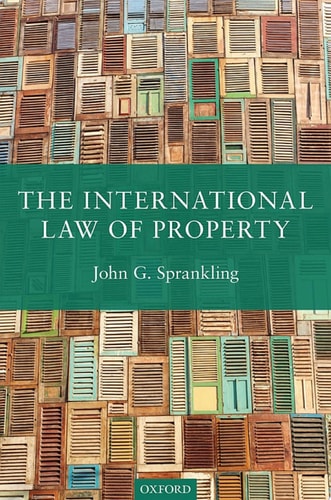
The International Law of Property
0
0
As an Amazon Associate and affiliate partner, Menrva Books earns from qualifying purchases. Learn more
Author Description
Does a right to property exist under international law? The traditional answer to this question is no: a right to property can only arise under the domestic law of a particular nation. But the view that property rights are exclusively governed by national law is obsolete. Identifiable areas of property law have emerged at the international level, and the foundation is now arguably being laid for a comprehensive international regime. This book provides a detailed investigation into this developing international property law. It demonstrates how the evolution of international property law has been influenced by major economic, political, and technological changes: the embrace of private property by former socialist states after the end of the Cold War; the globalization of trade; the birth of new technologies capable of exploiting the global commons; the rise of digital property; and the increasing recognition of the human right to property. The first part of the book analyzes how international law impacts rights in specific types of property. In some situations, international law creates property rights, such as rights in aboriginal lands, deep seabed minerals, and satellite orbits. In other areas, it harmonizes property rights that arise at the national level, such as rights in intellectual property, rights in foreign investments, and security interests in personal property. Finally, it restricts property rights that may be recognized at the national level, such as rights in celestial bodies, contraband, and slaves. The second part of the book explores the thesis that a global right to property should be recognized as a general matter, not merely as a moral precept but rather as an entitlement that all nations must honour. It establishes the components of such a right, arguing that the right to property at the international level should be seen in the context of five key components of ownership: acquisition, use, destruction, exclusion, and transfer.
Menrva's Summary
THE THESIS
Does a right to property exist under international law, and is the traditional view that property rights are exclusively domestic now obsolete? John G. Sprankling, a recognized scholar in property law, investigates the emergence of an international property regime. He argues that global economic, political, and technological shifts have necessitated a move beyond national boundaries, proposing that a comprehensive international right to property is currently forming.
THE SCOPE MAP
What You Will Find
- Analysis of international impacts on specific property types including aboriginal lands, deep seabed minerals, and satellite orbits.
- Examination of the harmonization of national property rights such as intellectual property and foreign investments.
- A theoretical framework defining the five components of ownership: acquisition, use, destruction, exclusion, and transfer.
Scope Limits
- The text does not provide a comprehensive manual for litigating specific international property disputes.
- It does not cover the entirety of domestic property law variations across every sovereign nation.
THE AUTHORITY PERSPECTIVE
Legal scholars and practitioners frequently cite this work as a foundational text for understanding the intersection of global governance and private ownership. Experts note that the book provides a rigorous academic framework for analyzing how international law increasingly constrains and defines property rights on a global scale.
Page Count:
422
Publication Date:
2014-01-01
Publisher:
OUP Oxford
ISBN-10:
0191502529
ISBN-13:
9780191502521
Economics
Professional Career & Trade
Property Law
Globalization
Law
Property
International Law
Community Tags
Other Editions(2)
Similar Books


Reader Comments
Share Your Thoughts
No comments yet. Be the first to share your thoughts!