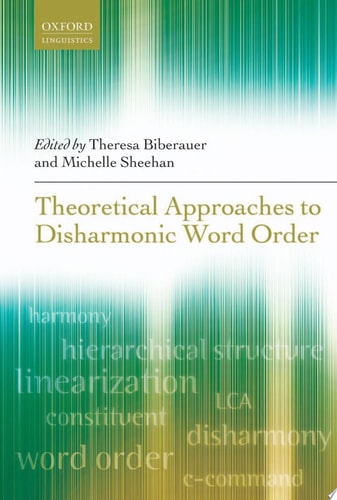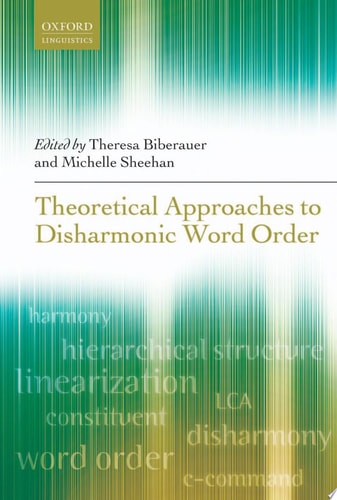
Theoretical Approaches to Disharmonic Word Order
0
0
As an Amazon Associate and affiliate partner, Menrva Books earns from qualifying purchases. Learn more
Author Description
This book considers the implications of cross-linguistic word-order patterns for linguistic theory. One of the salient results of Joseph Greenberg's pioneering work in language typology was the notion of a 'harmonic' word-order type, whereby if the verb appears at the left or right edge of the verb phrase, other heads (e.g. prepositions, nouns) also tend to do so. Today, however, there is recognition in both the typological and generative literature that very many, and possibly even the majority of languages, fail to be fully harmonic in the sense that all head-complement pairs pattern alike. But does this imply limitless variation? The chapters in this volume, written by international scholars, discuss the issues arising from this basic question, drawing on data from typologically distinct disharmonic languages, including Mandarin Chinese, Basque, Mócheno (a Tyrolean variety spoken in Northern Italy), French, English, Hixkaryana (a Cariban language), Khalkha Mongolian, Uyghur Turkic, and Afrikaans. The volume begins with a substantial introduction to the study of word order and its relation to linguistic theory. It is then divided into sections on the nature of disharmony; the role of prosody; the question of Antisymmetry and novel alternatives to Antisymmetry; and the Final-over-Final Constraint. Aside from introducing new empirical findings, the volume also offers a range of new perspectives on disharmonic word orders, the status of word order in linguistic theory, and theoretical accounts of typological gaps.
Menrva's Summary
THE THESIS
This volume investigates whether the prevalence of disharmonic word-order patterns in human languages necessitates a revision of current linguistic theories regarding typological variation. Editors Michelle Sheehan and Theresa Biberauer compile research from international scholars to examine why many languages deviate from the 'harmonic' word-order types proposed by Joseph Greenberg. The text evaluates whether these disharmonic patterns represent limitless variation or if they adhere to underlying structural constraints within generative and typological frameworks.
THE SCOPE MAP
What You Will Find
- Empirical data from diverse languages including Mandarin Chinese, Basque, French, and Afrikaans.
- Theoretical analysis of the Final-over-Final Constraint and Antisymmetry.
- Discussions on the influence of prosody and syntax on word-order patterns.
Scope Limits
- The text focuses primarily on generative and typological perspectives rather than sociolinguistic or historical language evolution.
- It does not provide an exhaustive survey of every known language family, focusing instead on specific case studies of disharmony.
THE AUTHORITY PERSPECTIVE
Experts identify this volume as a significant contribution to the study of syntactic typology and generative theory. Readers frequently note the academic density of the prose, making it a specialized resource intended for researchers and advanced students in linguistics.
Page Count:
480
Publication Date:
2013-01-01
Publisher:
OUP Oxford
ISBN-10:
0191507318
ISBN-13:
9780191507311
English
Academic
Linguistics
Syntax
English & College Success