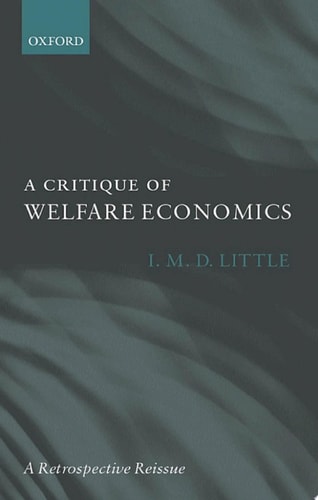
A Critique of Welfare Economics
0
0
As an Amazon Associate and affiliate partner, Menrva Books earns from qualifying purchases. Learn more
Author Description
A Critique of Welfare Economics was first published in 1950. It was concerned with the exposition, criticism, and appreciation of the theory of economic welfare as it had been developed to that date. It was an attempt to clarify what was meant by 'welfare'; to distinguish measurable, verifiable elements of the theory from subjective normative judgements about policies for improving economic well-being; and to establish criteria for determining whether one configuration of the economic system is better or worse than another. Little showed that the welfare theory of the time could be based directly on individual market choices, and that resort to traditional utilitarian concepts was not essential. A Critique of Welfare Economics is now reissued at the same time as Ethics, Economics, and Politics -- Little's latest book which explores the overlap between the three disciplines, and discusses the need for political decisions in economic matters, and the principles guiding them. He has added a new retrospective preface to Critique in which he assesses the contribution the book made in the light of subsequent literature in the area.
Menrva's Summary
THE THESIS
This work investigates the conceptual foundations of welfare economics to determine whether economic policy can be evaluated through objective criteria rather than subjective value judgments. I. M. D. Little, an influential economist, provides a rigorous examination of the prevailing theories of his time. He argues that welfare economics can be grounded in individual market choices, thereby challenging the necessity of traditional utilitarian frameworks for measuring economic well-being.
THE SCOPE MAP
What You Will Find
- A critical exposition of welfare theory as it existed in 1950
- A distinction between measurable economic data and normative policy judgments
- Criteria for comparing different configurations of an economic system
- A retrospective preface evaluating the book's long-term impact on the field
Scope Limits
- The text does not provide a comprehensive history of economic thought beyond the mid-20th century
- It excludes detailed empirical data sets, focusing instead on theoretical and logical frameworks
THE AUTHORITY PERSPECTIVE
Economists and scholars recognize this text as a foundational critique that successfully shifted the discourse toward individualistic choice models. Readers frequently note the high level of academic density and the logical rigor required to engage with Little's arguments.
Page Count:
323
Publication Date:
2002-01-01
Publisher:
OUP Oxford
ISBN-10:
0191501263
ISBN-13:
9780191501265
Economics
Economic Theory
Philosophy of
Public Policy
Community Tags
Similar Books