Author Description
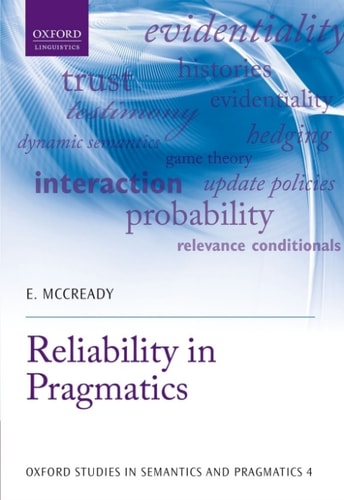
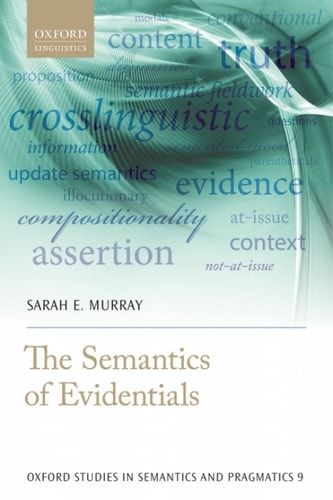
This book provides argues for a compositional, truth-conditional, crosslinguistic semantics for evidentiality, the linguistic encoding of the source of information on which a statement is based. Central to the proposed theory is the distinction between what propositional content is at-issue and what content is not-at-issue. Evidentials contribute not-at-issue content, and can affect the level of commitment a sentence makes to the main proposition, which is contributed by sentential mood. In this volume, Sarah Murray builds on recent work in the formal semantics of evidentials and related phenomena, and proposes a semantics that does not appeal to separate dimensions of illocutionary meaning. Instead, she argues that all sentences make three semantic contributions: at-issue content, not-at-issue content, and an illocutionary relation. At-issue content is presented and made available for subsequent anaphora, but is not directly added to the common ground; not-at-issue content directly updates the common ground; and the illocutionary relation uses a proposition to impose structure on the common ground, which, depending on the clause type, can trigger further updates. The analysis is supported by extensive empirical data from Cheyenne, drawn from the authors own fieldwork, as well as from English and a variety of other languages.
Menrva's Summary
THE THESIS
This book investigates the compositional, truth-conditional semantics of evidentiality by proposing a unified framework that distinguishes between at-issue and not-at-issue content. Sarah E. Murray, an expert in formal semantics, utilizes her own extensive fieldwork on the Cheyenne language alongside comparative data from English and other languages to challenge existing theories. She argues against the necessity of separate dimensions of illocutionary meaning, instead positing that all sentences perform three distinct semantic functions: contributing at-issue content, not-at-issue content, and an illocutionary relation.
THE SCOPE MAP
What You Will Find
- A formal semantic model for evidentials that avoids multi-dimensional illocutionary analysis.
- A detailed breakdown of how at-issue content, not-at-issue content, and illocutionary relations interact.
- Empirical linguistic data derived from original fieldwork on the Cheyenne language.
- Comparative analysis of evidential markers in English and various other language families.
Scope Limits
- The text focuses primarily on formal semantic and pragmatic theory rather than sociolinguistic or historical linguistic approaches to evidentiality.
- The analysis is restricted to the specific framework of compositional semantics and does not address broader cognitive or psychological theories of information source encoding.
THE AUTHORITY PERSPECTIVE
Experts in the field of formal semantics recognize this work as a significant contribution to the study of evidentiality and discourse structure. Readers frequently note the high level of technical density and the rigorous application of formal logic to linguistic data, making it a specialized text for advanced students and researchers in linguistics.
Page Count:
192
Publication Date:
2017-01-01
Publisher:
OUP Oxford
ISBN-10:
0191503797
ISBN-13:
9780191503795
Semantics
Pragmatics
Academic
Linguistics
English
English & College Success
Community Tags
Similar Books