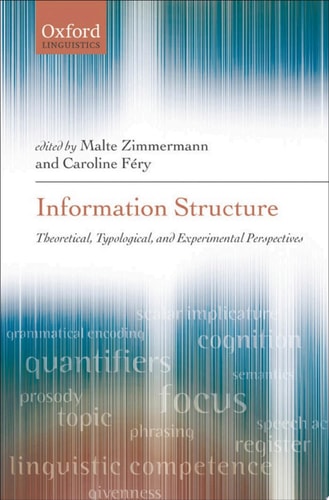
Information Structure: Theoretical, Typological, and Experimental Perspectives
0
0
As an Amazon Associate and affiliate partner, Menrva Books earns from qualifying purchases. Learn more
Author Description
In this book leading scholars provide state-of-the-art overviews of approaches to the formal expression of information structure in natural language and its interaction with general principles of human cognition and communication. They present critical accounts of current understanding of how aspects of grammar, such as prosody, syntax, morphology, semantics, and pragmatics, interact in the packing and unpacking of information in communication. They also look at the psycholinguistics behind the production and perception of information-structural categories. The book reflects the advances in recent research on all central aspects of the subject, including concepts of focus versus background, topic versus comment, and given versus new, and the kinds of inferences required to make sense of different combinations of words, syntax, intonation, and context. The chapters include typological and diachronic perspectives on information structure. Taken as a whole the book demonstrates the productive value of combining theoretical and experimental approaches.
Menrva's Summary
THE THESIS
This volume investigates the formal mechanisms of information structure in natural language and its integration with human cognition and communicative processes. Editors Caroline Féry and Malte Zimmermann compile contributions from leading scholars to examine how grammatical components—including prosody, syntax, and morphology—interact to encode and decode information. The text provides a critical synthesis of current research, bridging the gap between theoretical linguistic models and experimental psycholinguistic findings.
THE SCOPE MAP
What You Will Find
- Analysis of core information-structural categories such as focus, background, topic, and comment.
- Examination of the interaction between semantics, pragmatics, and syntactic structure.
- Integration of typological and diachronic perspectives on linguistic evolution.
- Experimental data regarding the production and perception of information-structural cues.
Scope Limits
- The text does not provide a comprehensive introductory survey for non-specialists.
- It focuses primarily on formal and experimental linguistics rather than applied sociolinguistic analysis.
THE AUTHORITY PERSPECTIVE
Experts identify this volume as a comprehensive reference for researchers and advanced students interested in the intersection of grammar and cognition. Readers frequently note the academic density of the prose, which assumes a foundational understanding of formal linguistic theory.
Page Count:
352
Publication Date:
2009-01-01
Publisher:
OUP Oxford
ISBN-10:
0191610100
ISBN-13:
9780191610103
English
Syntax
Pragmatics
Psycholinguistics
Semantics
Linguistics
English & College Success
Community Tags
Similar Books