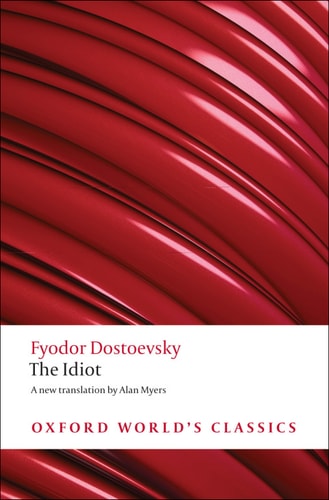
The Idiot
0
0
As an Amazon Associate and affiliate partner, Menrva Books earns from qualifying purchases. Learn more
Author Description
Into a compellingly real portrait of nineteenth-century Russian society, Dostoevsky introduces his ideal hero, the saintly Prince Myshkin. The tensions subsequently unleashed by the hero's innocence, truthfulness, and humility betray the inadequacy of his moral idealism and disclose the spiritual emptiness of a society that cannot accommodate him. Myshkin's mission ends in idiocy and darkness, but it is the world that is rotten, not he. Written under appalling personal circumstances when Dostoevsky was travelling in Europe, The Idiot not only reveals the author's acute artistic sense and penetrating psychological insight, but also affords his most incisive indictment of Russia's struggling to emulate contemporary Europe and sinking under the weight of Western materialism. This new translation by Alan Myers is meticulously faithful to the original and has a critical introduction by W. J. Leatherbarrow. ABOUT THE SERIES: For over 100 years Oxford World's Classics has made available the widest range of literature from around the globe. Each affordable volume reflects Oxford's commitment to scholarship, providing the most accurate text plus a wealth of other valuable features, including expert introductions by leading authorities, helpful notes to clarify the text, up-to-date bibliographies for further study, and much more.
Menrva's Summary
THE PULSE
The arrival of the saintly Prince Myshkin in nineteenth-century St. Petersburg acts as a catalyst for the moral and social unraveling of the Russian elite. Prince Myshkin, a man of profound innocence and humility, attempts to navigate the complex, materialistic, and often cruel social circles of the Russian aristocracy. His presence forces those around him to confront their own moral failings, yet his inability to reconcile his idealism with the harsh realities of human greed leads to tragic consequences. The narrative framework utilizes a third-person perspective to observe the psychological disintegration of the characters as they interact with the Prince's uncompromising truthfulness.
INSIDE THE PAGES
- Exploration of moral idealism versus societal corruption
- Detailed psychological character studies
- Satirical critique of Western materialism in Russia
- Complex, multi-layered dialogue sequences
- Themes of epilepsy and spiritual suffering
- Intricate social maneuvering and class tension
- Non-linear progression of interpersonal conflicts
- Symbolic use of the protagonist as a Christ-like figure
THE COLLECTIVE ECHO
Discussion often centers on the stark contrast between Prince Myshkin’s inherent goodness and the cynical, ego-driven environment of the Russian upper class. Readers frequently highlight the intense psychological depth Dostoevsky achieves, noting how the pacing mirrors the erratic mental states of the primary characters. Critics often examine the author's critique of contemporary European influence on Russian values, viewing the novel as a profound indictment of societal decay. The work is widely recognized for its ability to maintain a sense of dread while simultaneously presenting moments of profound human vulnerability. Many readers find the conclusion particularly challenging, as it forces a re-evaluation of the protagonist's impact on the world around him.
Page Count:
692
Publication Date:
2008-01-01
Publisher:
OUP Oxford
ISBN-10:
0191505846
ISBN-13:
9780191505843
Psychological
Realism
Classic Literature
English
Philosophical
Russian
English & College Success
Community Tags
Similar Books