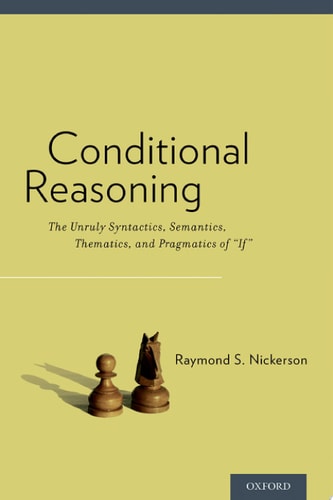
Conditional Reasoning: The Unruly Syntactics, Semantics, Thematics, and Pragmatics of "If"
0
0
As an Amazon Associate and affiliate partner, Menrva Books earns from qualifying purchases. Learn more
Author Description
Conditional reasoning is reasoning that involves statements of the sort If A (Antecedent) then C (Consequent). This type of reasoning is ubiquitous; everyone engages in it. Indeed, the ability to do so may be considered a defining human characteristic. Without this ability, human cognition would be greatly impoverished. "What-if" thinking could not occur. There would be no retrospective efforts to understand history by imagining how it could have taken a different course. Decisions that take possible contingencies into account could not be made; there could be no attempts to influence the future by selecting actions on the basis of their expected effects. Despite the commonness and importance of conditional reasoning and the considerable attention it has received from scholars, it remains the subject of much continuing debate. Unsettled questions, both normative and empirical, continue to be asked. What constitutes normative conditional reasoning? How do people engage in it? Does what people do match what would be expected of a rational agent with the abilities and limitations of human beings? If not, how does it deviate and how might people's ability to engage in it be improved?This book reviews the work of prominent psychologists and philosophers on conditional reasoning. It describes empirical research on how people deal with conditional arguments and on how conditional statements are used and interpreted in everyday communication. It examines philosophical and theoretical treatments of the mental processes that support conditional reasoning. Its extensive coverage of the subject makes it an ideal resource for students, teachers, and researchers with a focus on cognition across disciplines.
Menrva's Summary
THE THESIS
This book investigates the cognitive mechanisms, normative standards, and linguistic complexities inherent in conditional reasoning, specifically the 'if-then' logical structure. Raymond Nickerson, a noted researcher in cognitive psychology, synthesizes decades of empirical research and philosophical inquiry to address how humans process hypothetical scenarios. The work evaluates the gap between ideal rational agency and actual human performance, providing a framework for understanding why conditional reasoning remains a subject of intense academic debate.
THE SCOPE MAP
What You Will Find
- Analysis of the syntactic, semantic, and pragmatic dimensions of conditional statements.
- Review of psychological research regarding human performance on conditional arguments.
- Philosophical perspectives on the mental processes supporting 'what-if' thinking.
- Discussion of normative versus descriptive models of reasoning.
Scope Limits
- The text does not provide a self-help guide for improving personal decision-making skills.
- It does not focus on formal symbolic logic systems independent of human cognitive application.
THE AUTHORITY PERSPECTIVE
Experts recognize this work as a comprehensive synthesis of interdisciplinary research on human reasoning. Readers frequently note the academic density of the prose, making it a valuable reference for students and researchers in cognitive science and philosophy.
Page Count:
472
Publication Date:
2015-01-01
Publisher:
Oxford University Press
ISBN-10:
0190203013
ISBN-13:
9780190203016
Non-Fiction
Philosophy
Linguistics
Cognitive Psychology
Epistemology
Logic
Community Tags
Similar Books