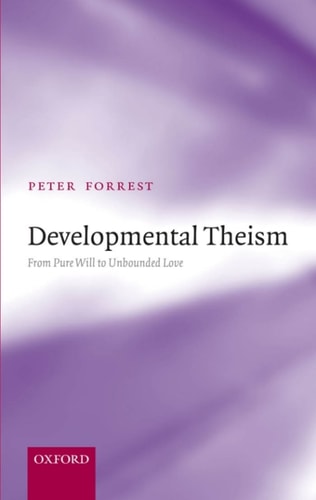
Developmental Theism: From Pure Will to Unbounded Love
0
0
As an Amazon Associate and affiliate partner, Menrva Books earns from qualifying purchases. Learn more
Author Description
This is a work of speculative theology based on three themes: that a version of materialism is a help not a hindrance in philosophical theology; that God develops; and that this development is on the whole kenotic, in other words an abandonment of power. Peter Forrest argues that the resulting kenotic theism might well be correct. He claims that his hypothesis concerning God is better than known rival hypotheses, including atheism, and that if there is no unknown better hypothesis it is good enough to be believed. In the Introduction he offers a defense of the type of metaphysical speculation on which his thesis rests. Elsewhere in the book he defends his 'moderate materialism', expounds the notion of the 'Primordial God', and discusses how God changes. In the resulting account, Forrest reconciles the unloving and unlovable God of the philosophers with the God of the Abrahamic tradition. In a quasi-Gnostic fashion he puts the blame for evils on the Primordial God and argues that after God has become loving, the divine powers of intervention are limited by the natural order. In the final two chapters he applies this kenotic theism to specifically Christian teachings, notably the Trinity and the Incarnation.
Menrva's Summary
THE THESIS
This work investigates whether a model of a developing, kenotic God can reconcile philosophical theology with the Abrahamic tradition while remaining superior to atheistic alternatives. Peter Forrest, a philosopher of religion, utilizes a framework of moderate materialism to argue that God undergoes a process of development characterized by the abandonment of divine power. He posits that this kenotic theism provides a coherent explanation for the existence of evil and the limitations of divine intervention within the natural order.
THE SCOPE MAP
What You Will Find
- A defense of metaphysical speculation as a valid theological tool
- An exposition of the 'Primordial God' concept
- A reconciliation of philosophical divine attributes with Abrahamic traditions
- Application of kenotic theory to the Trinity and the Incarnation
Scope Limits
- The text does not provide an exhaustive survey of all historical theological models
- It does not address non-theistic religious traditions outside of the Abrahamic framework
THE AUTHORITY PERSPECTIVE
Scholars and students of philosophy of religion frequently note the high level of technical density in Forrest's prose. Experts highlight this text as a significant contribution to speculative theology for those interested in the intersection of materialism and divine evolution.
Page Count:
206
Publication Date:
2007-01-01
Publisher:
Clarendon Press
ISBN-10:
0191514209
ISBN-13:
9780191514203
Philosophy
Philosophy of
Christian Theology
Theology
Metaphysics
Community Tags
Similar Books