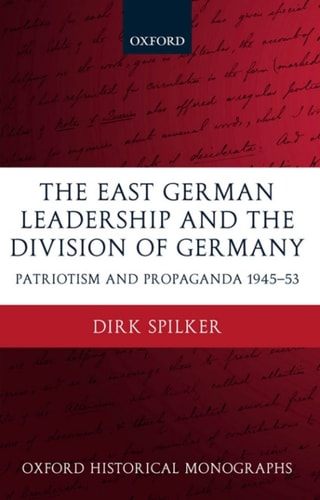
The East German Leadership and the Division of Germany: Patriotism and Propaganda 1945-1953
0
0
As an Amazon Associate and affiliate partner, Menrva Books earns from qualifying purchases. Learn more
Author Description
Would it have been possible to build a unified and democratic Germany half a century before the fall of the Berlin Wall? This book reassesses this question by exploring Germany's division after the Second World War from the point of view of the SED, the communist-led and Soviet-sponsored ruling party of East Germany. Drawing on unpublished documents from the SED archives, Dr Spilker rejects claims that the East German comrades and their Soviet masters had abandoned their struggle for socialism and were willing to accept a democratic Germany in exchange for a pledge to neutrality. He argues that the communists' sudden switch to a multi-party approach at the end of the war was a tactical move inspired not by a desire for compromise but by the mistaken belief that they could win political hegemony - and the chance to introduce socialism throughout Germany - through the ballot box. Communist optimism, as this book shows, rested on specific assumptions about the situation after the war, all of which revolved around the prospect of political instability and social unrest in West Germany. The comrades in East Berlin did not just say that their regime would ultimately prevail, they genuinely believed it. Nor should their hopes be dismissed as a mere fantasy. In the aftermath of the war, the economic gap between the two Germanies was still relatively narrow and West Germany's future success as a magnet for the people in East Germany was by no means guaranteed.
Menrva's Summary
THE THESIS
This book investigates whether a unified, democratic Germany was a viable possibility in the immediate post-World War II era by analyzing the strategic motivations of the Socialist Unity Party (SED). Dr. Dirk Spilker, utilizing previously unpublished documents from SED archives, challenges the narrative that East German leadership was prepared to sacrifice socialist goals for a neutral, democratic state. He argues that the party's early embrace of multi-party politics was a calculated tactical maneuver based on the genuine, albeit flawed, belief that they could achieve political hegemony across all of Germany through democratic processes.
THE SCOPE MAP
What You Will Find
- Analysis of SED political strategy between 1945 and 1953
- Examination of Soviet-East German party relations
- Assessment of post-war economic conditions in both Germanies
- Evaluation of communist assumptions regarding West German political instability
Scope Limits
- The study focuses primarily on the internal perspective of the SED leadership
- The narrative concludes in 1953, excluding the later decades of the Cold War
THE AUTHORITY PERSPECTIVE
Historians and scholars of the Cold War recognize this work as a rigorous archival study that provides a necessary corrective to traditional interpretations of East German political intent. Readers frequently note the academic density of the prose, which makes it a specialized resource for those studying the early formation of the German Democratic Republic.
Page Count:
320
Publication Date:
2006-01-01
Publisher:
Clarendon Press
ISBN-10:
0191515825
ISBN-13:
9780191515828
History
Cold War
Germany history
Politics & Government
Communism
German history
European History
Community Tags
Similar Books