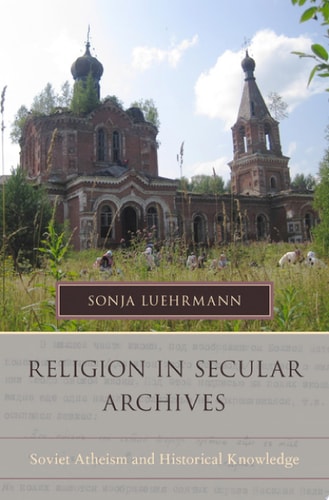
Religion in Secular Archives: Soviet Atheism and Historical Knowledge
0
0
As an Amazon Associate and affiliate partner, Menrva Books earns from qualifying purchases. Learn more
Author Description
What can atheists tell us about religious life? Russian archives contain a wealth of information on religiosity during the Soviet era, but most of it is written from the hostile perspective of officials and scholars charged with promoting atheism. Based on archival research in locations as diverse as the multi-religious Volga region, Moscow, and Texas, Sonja Luehrmann argues that we can learn a great deal about Soviet religiosity when we focus not just on what documents say but also on what they did. Especially during the post-war decades (1950s-1970s), the puzzle of religious persistence under socialism challenged atheists to develop new approaches to studying and theorizing religion while also trying to control it. Taking into account the logic of filing systems as well as the content of documents, the book shows how documentary action made religious believers firmly a part of Soviet society while simultaneously casting them as ideologically alien. When juxtaposed with oral, printed, and samizdat sources, the records of institutions such as the Council of Religious Affairs and the Communist Party take on a dialogical quality. In distanced and carefully circumscribed form, they preserve traces of encounters with religious believers. By contrast, collections compiled by western supporters during the Cold War sometimes lack this ideological friction, recruiting Soviet believers into a deceptively simple binary of religion versus communism. Through careful readings and comparisons of different documentary genres and depositories, this book opens up a difficult set of sources to students of religion and secularism.
Menrva's Summary
THE THESIS
This book investigates how the hostile documentation produced by Soviet atheist officials can be repurposed to understand the lived reality of religious persistence under socialism. Sonja Luehrmann, an anthropologist and historian, utilizes archival records from the Council of Religious Affairs and the Communist Party to challenge traditional interpretations of Soviet secularism. By analyzing the mechanics of state filing systems alongside oral and samizdat sources, she argues that these documents reveal a complex, dialogical relationship between the state and religious believers that transcends simple binary narratives.
THE SCOPE MAP
What You Will Find
- Analysis of Soviet archival practices and administrative filing systems from the 1950s to the 1970s.
- Comparative study of state-produced documents versus Western Cold War collections.
- Methodological framework for reading ideologically charged documents against the grain.
Scope Limits
- The study focuses primarily on the post-war Soviet era and does not provide a comprehensive history of religion across the entire Soviet timeline.
- The research does not attempt to provide a complete sociological survey of all religious denominations within the USSR.
THE AUTHORITY PERSPECTIVE
Scholars in the field of Soviet history and religious studies recognize this work as a sophisticated methodological intervention in archival research. Readers frequently note the academic density of the prose, which provides a nuanced look at how state institutions inadvertently preserved the voices of those they sought to suppress.
Page Count:
252
Publication Date:
2015-01-01
Publisher:
Oxford University Press
ISBN-10:
019046352X
ISBN-13:
9780190463526
Religion
History
European History
Sociology of Religion
American Religions
Atheism
Cold War
Soviet Studies
Community Tags
Similar Books