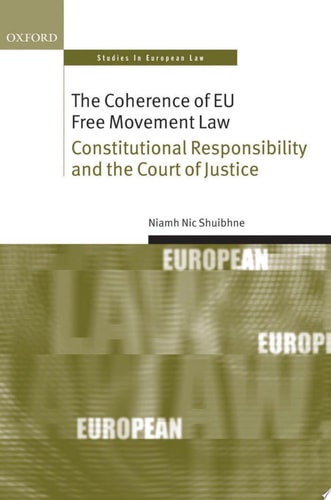
The Coherence Of EU Free Movement Law
0
0
As an Amazon Associate and affiliate partner, Menrva Books earns from qualifying purchases. Learn more
Author Description
At The Heart Of The European Union Is The Establishment Of A European Market Grounded In The Free Movement Of People, Goods, Services, And Capital. The Implementation Of The Free Market Has Preoccupied European Lawyers Since The Inception Of The Union's Predecessors. Throughout The Union's Development, As Obstacles To Free Movement Have Been Challenged In The Courts, The European Court Of Justice Has Had To Expand On The Internal Market Provisions In The Founding Treaties To Create A Body Of Law Determining The Scope And Meaning Of The Eu Protection Of Free Movement. In Doing So, The Court Has Often Taken Differing Approaches Across The Different Freedoms, Leaving A Body Of Law Apparently Lacking A Coherent Set Of Foundational Principles. This Book Presents A Critical Analysis Of The European Courts' Jurisprudence On Free Movement, Examining The Court's Constitutional Responsibility To Articulate A Coherent Vision Of The Eu Internal Market. Through Analysis Of Restrictions On Free Movement Rights, It Argues That Four Main Drivers Are Distorting The System Of The Case Law And Its Claims To Coherence. The Drivers Reflect 'good' Impulses (the Protection Of Fundamental Rights); Avoidable Habits (the Proliferation Of Principles And Conflicting Lines Of Case Law Authority); Inherent Ambiguities (the Unsettled Purpose And Objectives Of The Internal Market); And Broader Systemic Conditions (the Structure Of The Court And Its Decision-making Processes). These Dynamics Cause Problematic Instances Of Case Law Fragmentation - Which Has Substantive Implications For Citizens, Businesses, And Member States Participating In The Internal Market As Well As Reputational Consequences For The Court Of Justice And For The Eu More Generally. However, Ultimately The Member States Must Take Greater Responsibility Too: Only They Can Ensure That The Court Of Justice Is Properly Structured And Supported, Enabling It To Play Its Critical Institutional Part In The Complex Narrative Of Eu Integra
Menrva's Summary
THE THESIS
This book investigates whether the European Court of Justice has successfully articulated a coherent set of foundational principles for the internal market's free movement laws. Niamh Nic Shuibhne, a professor of European Union law, utilizes an extensive analysis of judicial jurisprudence to evaluate how the Court manages the four freedoms of the EU. The author argues that the current body of law suffers from fragmentation caused by conflicting judicial impulses, systemic structural constraints, and inherent ambiguities regarding the purpose of the internal market.
THE SCOPE MAP
What You Will Find
- A critical examination of the European Court of Justice's case law regarding the free movement of people, goods, services, and capital.
- A framework identifying four primary drivers of legal distortion: fundamental rights protection, procedural habits, market purpose ambiguities, and institutional structure.
- An assessment of the impact of legal fragmentation on citizens, businesses, and member states.
Scope Limits
- The text does not provide a comprehensive history of all EU treaties, focusing instead on the judicial interpretation of existing provisions.
- The analysis does not offer a detailed legislative roadmap for future treaty reform, concentrating primarily on the role of the Court.
THE AUTHORITY PERSPECTIVE
Legal scholars and practitioners frequently cite this work as a rigorous examination of the internal tensions within EU jurisprudence. Experts highlight the author's ability to synthesize complex case law into a clear, critical framework for understanding institutional decision-making.
Page Count:
310
Publication Date:
2013-01-01
Publisher:
Oup Oxford
ISBN-10:
0191511056
ISBN-13:
9780191511059
European Union
International Trade
Constitutional Law
Law
Jurisprudence
Community Tags
Other Editions(2)
Similar Books



Reader Comments
Share Your Thoughts
No comments yet. Be the first to share your thoughts!