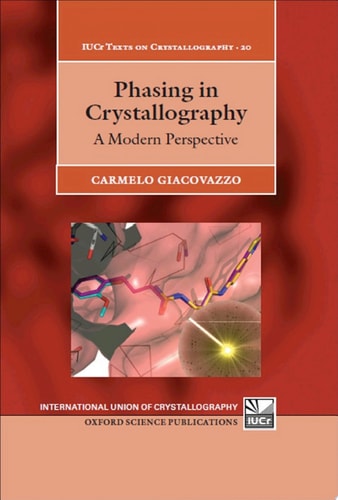
Phasing in Crystallography: A Modern Perspective
0
0
As an Amazon Associate and affiliate partner, Menrva Books earns from qualifying purchases. Learn more
Author Description
Modern crystallographic methods originate from the synergy of two main research streams, the small-molecule and the macro-molecular streams. The first stream was able to definitively solve the phase problem for molecules up to 200 atoms in the asymmetric unit. The achievements obtained by the macromolecular stream are also impressive. A huge number of protein structures have been deposited in the Protein Data Bank. The solution of them is no longer reserved to an elite group of scientists, but may be attained in a large number of laboratories around the world, even by young scientists. New probabilistic approaches have been tailored to deal with larger structures, errors in the experimental data, and modest data resolution. Traditional phasing techniques like ab initio, molecular replacement, isomorphous replacement, and anomalous dispersion techniques have been revisited. The new approaches have been implemented in robust phasing programs, which have been organized in automatic pipelines usable even by non-experts. Protein structures, which 50 years ago could take months or even years to solve, can now be solved in a matter of hours, partly also due to technological advances in computer science. This book describes all modern crystallographic phasing methods, and introduces a new rational classification of them. A didactic approach is used, with the techniques described simply and logically in the main text, and further mathematical details confined to the Appendices for motivated readers. Numerous figures and applicative details illustrate the text.
Menrva's Summary
THE THESIS
This book investigates the evolution and current state of crystallographic phasing methods, addressing how modern computational and probabilistic approaches have democratized the process of solving complex molecular structures. Author Carmelo Giacovazzo, a recognized expert in the field, synthesizes decades of research from both small-molecule and macromolecular streams. He presents a rational classification of phasing techniques, arguing that the integration of automated pipelines and robust probabilistic models has transformed a once-exclusive scientific endeavor into a standard laboratory practice. The text balances conceptual clarity with rigorous mathematical foundations to explain how researchers can now resolve protein structures in hours rather than years.
THE SCOPE MAP
What You Will Find
- A comprehensive review of traditional phasing techniques including ab initio, molecular replacement, isomorphous replacement, and anomalous dispersion.
- A new rational classification system for modern crystallographic methods.
- Didactic explanations of complex phasing algorithms paired with practical application details.
Scope Limits
- The text does not provide an exhaustive history of early 20th-century crystallography.
- Advanced mathematical proofs are relegated to the appendices rather than the primary narrative flow.
THE AUTHORITY PERSPECTIVE
Experts and students frequently cite this work as a definitive resource for understanding the transition from manual to automated phasing in structural biology. Readers note that the didactic structure makes the dense material accessible to both seasoned researchers and those new to the field.
Page Count:
480
Publication Date:
2013-01-01
Publisher:
OUP Oxford
ISBN-10:
0191510629
ISBN-13:
9780191510625
Science
Chemistry
Physics
Academic
Earth Sciences
Community Tags
Other Editions(2)

Similar Books