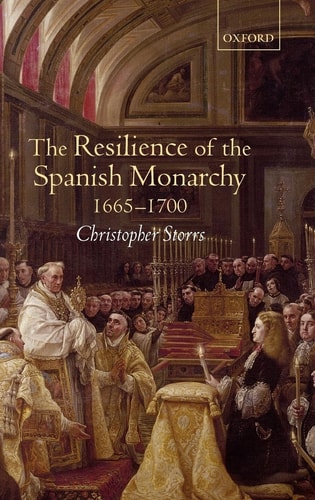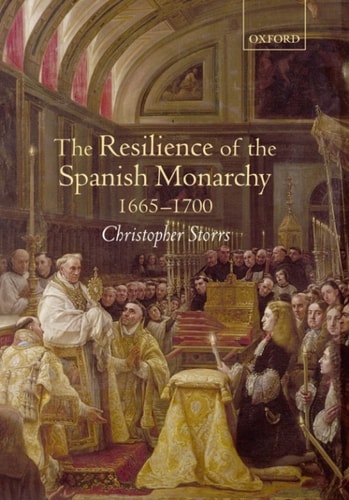
The Resilience of the Spanish Monarchy 1665-1700
0
0
As an Amazon Associate and affiliate partner, Menrva Books earns from qualifying purchases. Learn more
Author Description
Christopher Storrs presents a fresh new appraisal of the reasons for the survival of Spain and its European and overseas empire under the last Spanish Habsburg, Carlos II (1665-1700). Hitherto it has been largely assumed that in the 'Age of Louis XIV' Spain collapsed as a military, naval and imperial power, and only retained its empire because states which had hitherto opposed Spanish hegemony came to Carlos's aid. However, this view seriously underestimates the efforts of Carlos II and his ministers to raise men to fight in Spain's various armies - above all in Flanders, Lombardy, and Catalonia - and to ensure that Spain continued to have galleons in the Atlantic and galleys in the Mediterranean. These commitments were expensive, so that the fiscal pressures on Carlos' subjects to fund the empire continued to be considerable. Not surprisingly, these demands added to the political tensions in a reign in which the succession problem already generated difficulties. They also put pressure on an administrative structure which revealed some weaknesses but which also proved its worth in time of need. The burden of empire was still largely carried in Spain by Castile (assisted by the silver of the Indies), but Spain's ability to hang onto empire was also helped by a greater integration of centre and periphery, and by the contribution of the non-Castilian territories, notably Aragon in Spain and Naples in Spanish Italy. This book radically revises our understanding of the last decades of Habsburg Spain. As Storrs demonstrates, it was a state and society more clearly committed to the retention of empire - and more successful in achieving this - than historians have hitherto acknowledged.
Menrva's Summary
THE THESIS
This work investigates the mechanisms that allowed the Spanish Empire to survive and maintain its global influence during the reign of Carlos II, challenging the traditional narrative of inevitable decline. Christopher Storrs, a specialist in early modern European history, utilizes archival evidence and administrative records to argue that the Spanish state remained a functional and committed imperial power. He posits that the survival of the Habsburg empire was not merely a result of foreign intervention, but a consequence of deliberate fiscal, military, and administrative efforts by the crown and its ministers.
THE SCOPE MAP
What You Will Find
- Analysis of military mobilization in Flanders, Lombardy, and Catalonia
- Examination of fiscal policies and the burden on the Castilian economy
- Assessment of the integration between the Spanish center and peripheral territories like Aragon and Naples
Scope Limits
- The study focuses specifically on the period between 1665 and 1700
- It does not provide a comprehensive biography of Carlos II beyond his role as a political administrator
THE AUTHORITY PERSPECTIVE
Historians recognize this text as a significant revisionist contribution to the study of the late Spanish Habsburg period. Scholars frequently note that the book provides a necessary corrective to long-standing assumptions regarding the collapse of Spanish imperial power.
Page Count:
288
Publication Date:
2006-01-01
Publisher:
OUP Oxford
ISBN-10:
0191514322
ISBN-13:
9780191514326
History
Spanish History
Military History
History - Modern
Political History
Modern History
European History