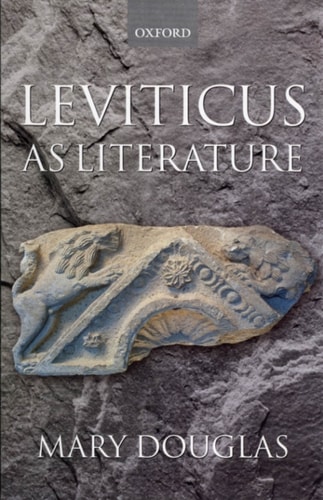
Leviticus As Literature
0
0
As an Amazon Associate and affiliate partner, Menrva Books earns from qualifying purchases. Learn more
Author Description
This first full-scale account of Leviticus by a world renowned anthropologist presents the biblical work as a literary masterpiece. Seen in an anthropological perspective Leviticus has a mystical structure which plots the book into three parts corresponding to the three parts of the desert tabernacle, both corresponding to the parts of Mount Sinai. This completely new reading transforms the interpretation of the purity laws. The pig and other forbidden animals are not abhorrent, they command the same respect due to all God's creatures. Boldly challenging several traditions of Bible criticism, Mary Douglas claims that Leviticus is not the narrow doctrine of a crabbed professional priesthood but a powerful intellectual statement about a religion which emphasizes God's justice and compassion.
Menrva's Summary
THE THESIS
Does the book of Leviticus possess a coherent, intentional literary structure that reflects a sophisticated theological framework rather than a disjointed collection of priestly regulations? Mary Douglas, a renowned anthropologist, applies structuralist analysis to the biblical text to argue that Leviticus is a unified, intellectual work. By mapping the text onto the physical layout of the desert tabernacle and Mount Sinai, she posits that the book serves as a deliberate statement on divine justice and compassion.
THE SCOPE MAP
What You Will Find
- A structural analysis comparing the text of Leviticus to the architecture of the tabernacle
- A re-evaluation of biblical purity laws and dietary restrictions
- An anthropological framework for interpreting ancient religious texts
Scope Limits
- The book does not provide a verse-by-verse commentary or linguistic exegesis
- It does not focus on the historical development of the priesthood outside of its literary context
THE AUTHORITY PERSPECTIVE
Scholars and theologians frequently cite this work for its innovative application of anthropological methods to biblical criticism. Readers often note that while the prose is intellectually dense, it provides a significant shift in how the purity laws are understood within the broader context of religious literature.
Page Count:
304
Publication Date:
2001-01-01
Publisher:
Oxford University Press
ISBN-10:
0191518387
ISBN-13:
9780191518386
Religion
Anthropology
Theology
Criticism history
Bibles
Literary Criticism
Bible as literature
Community Tags
Similar Books