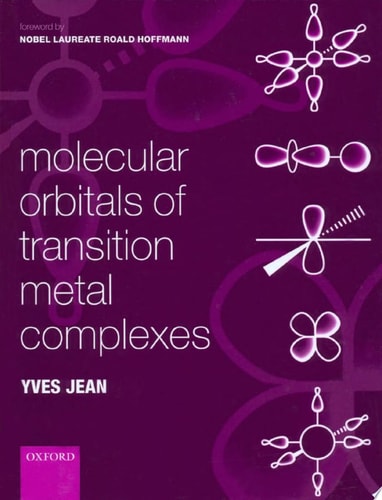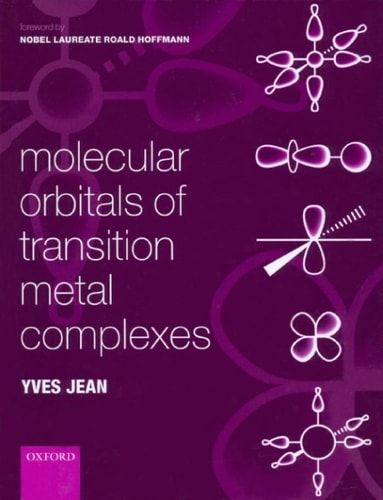
Molecular Orbitals of Transition Metal Complexes
0
0
As an Amazon Associate and affiliate partner, Menrva Books earns from qualifying purchases. Learn more
Author Description
This book starts with the most elementary ideas of molecular orbital theory and leads the reader progressively to an understanding of the electronic structure, geometry and, in some cases, reactivity of transition metal complexes. The qualitative orbital approach, based on simple notions such as symmetry, overlap and electronegativity, is the focus of the presentation and a substantial part of the book is associated with the mechanics of the assembly of molecular orbital diagrams. The first chapter recalls the basis for electron counting in transition metal complexes. The main ligand fields (octahedral, square planar, tetrahedral, etc.) are studied in the second chapter and the structure of the "d block" is used to trace the relationships between the electronic structure and the geometry of the complexes. The third chapter studies the change in analysis when the ligands have pi-type interactions with the metal. All these ideas are then used in the fourth chapter to study a series of selected applications of varying complexity (e.g. structure and reactivity). The fifth chapter deals with the "isolobal analogy" which points out the resemblance between the molecular orbitals of inorganic and organic species and provides a bridge between these two subfields of chemistry. The last chapter is devoted to a presentation of basic Group Theory with applications to some of the complexes studied in the earlier chapters.
Menrva's Summary
THE THESIS
This book investigates the relationship between electronic structure, geometry, and reactivity in transition metal complexes through the application of qualitative molecular orbital theory. Yves Jean, a specialist in theoretical chemistry, utilizes a pedagogical framework that builds from fundamental electron counting to advanced concepts like the isolobal analogy. The text emphasizes symmetry, orbital overlap, and electronegativity as the primary tools for constructing molecular orbital diagrams.
THE SCOPE MAP
What You Will Find
- Systematic construction of molecular orbital diagrams for octahedral, square planar, and tetrahedral ligand fields.
- Analysis of pi-type ligand interactions and their impact on metal complex structure.
- Introduction to the isolobal analogy bridging inorganic and organic chemistry.
- Foundational applications of Group Theory to transition metal systems.
Scope Limits
- The text focuses on qualitative approaches rather than high-level computational or quantitative quantum mechanical calculations.
- It does not provide an exhaustive survey of all organometallic reaction mechanisms beyond selected illustrative examples.
THE AUTHORITY PERSPECTIVE
Experts and students frequently identify this text as a clear, accessible introduction to the qualitative aspects of inorganic electronic structure. Readers often note that the book serves as a bridge between basic undergraduate chemistry and more advanced theoretical research in the field.
Page Count:
263
Publication Date:
2005-01-01
Publisher:
OUP Oxford
ISBN-10:
0191513695
ISBN-13:
9780191513695
Inorganic Chemistry
Physical Chemistry
Solid state chemistry
Chemistry
Earth Sciences
Academic Textbooks
Molecular Orbital Theory