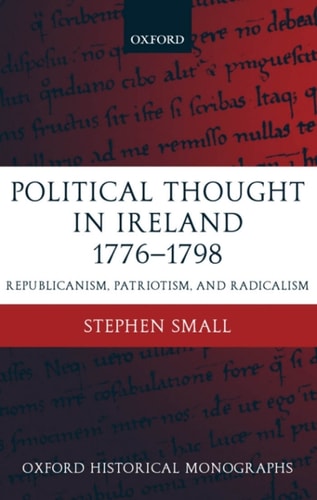
Political Thought in Ireland 1776-1798: Republicanism, Patriotism, and Radicalism
0
0
As an Amazon Associate and affiliate partner, Menrva Books earns from qualifying purchases. Learn more
Author Description
This is the first comprehensive analysis of late eighteenth-century Irish patriot thought and its development into 1790s radical republicanism. The book is a history of the rich political ideas and languages that emerged from the tumultuous events and colourful individuals of this pivotal period in Irish history. Patriots, radicals, and republicans played key roles in the movements for free trade, legislative independence, parliamentary reform, Catholic relief and independence from Britain; and many of their ideas helped precipitate the rebellion in 1798. Stephen Small explains the ideological background to these issues, sheds new light on the origins of Irish republicanism, and places late eighteenth-century Irish political thought in the wider context of British, Atlantic, and European ideas. Dr Small argues that Irish patriotism, radicalism, and republicanism were constructed out of five key political 'languages': Protestant superiority, ancient constitutionalism, commercial grievance, classical republicanism, and natural rights. These political languages, which were Irish dialects of languages shared with the English-speaking and European world, combined in the late 1770s to construct the classic expression of Irish patriotism. This patriotism was full of contradictions, containing the seeds of radical reform, Catholic emancipation, and republican separatism - as well as a defence of Protestant Ascendancy. Over the next two decades, the American and French Revolutions, the reform movement, popular politicization, Ascendancy reaction, and Catholic political revival disrupted and transformed these languages, causing the fragmentation of a broad patriot consensus and the emergence from it of radicalism and republicanism. These developments are explained in terms of tensions and interactions between Protestant assumptions of Catholic inferiority, the increasing popularity of natural rights, and the enduring centrality of classical republican concepts of virtue to al
Menrva's Summary
THE THESIS
This work investigates the ideological evolution of Irish political thought from 1776 to 1798, specifically tracing the transition from patriot reformism to radical republicanism. Stephen Small, a historian specializing in the late eighteenth-century Atlantic world, utilizes a framework of five distinct political languages to analyze how Irish thinkers navigated the pressures of the American and French Revolutions. By examining primary source documents and contemporary political discourse, Small argues that these competing languages—ranging from ancient constitutionalism to natural rights—created a volatile environment that ultimately precipitated the 1798 rebellion.
THE SCOPE MAP
What You Will Find
- Analysis of five core political languages: Protestant superiority, ancient constitutionalism, commercial grievance, classical republicanism, and natural rights.
- Historical examination of the movements for free trade, legislative independence, and Catholic relief.
- Contextualization of Irish political thought within the broader British, Atlantic, and European intellectual spheres.
Scope Limits
- The analysis is strictly confined to the period between 1776 and 1798.
- The text focuses primarily on elite and intellectual political discourse rather than grassroots social history.
THE AUTHORITY PERSPECTIVE
Scholars recognize this monograph as a rigorous contribution to the intellectual history of the Irish revolutionary period. Readers frequently note the academic density of the prose, which serves as a foundational text for understanding the ideological complexities of the late eighteenth century.
Page Count:
290
Publication Date:
2003-01-01
Publisher:
Clarendon Press
ISBN-10:
0191514543
ISBN-13:
9780191514548
History
Ireland
18th century
Politics & Government
Political Philosophy
European History
Irish History