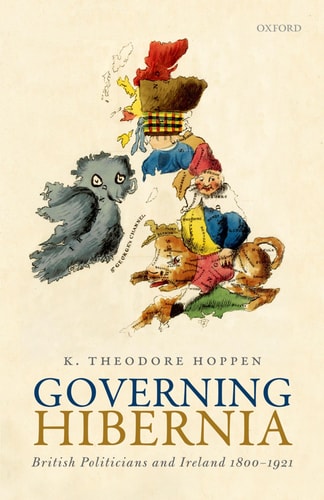
Governing Hibernia: British Politicians and Ireland 1800-1921
0
0
As an Amazon Associate and affiliate partner, Menrva Books earns from qualifying purchases. Learn more
Author Description
The Anglo-Irish Union of 1800 which established the United Kingdom of Great Britain and Ireland made British ministers in London more directly responsible for Irish affairs than had previously been the case. The Act did not, however, provide for full integration, and left in existence a separate administration in Dublin under a Viceroy and a Chief Secretary. This created tensions that were never resolved. The relationship that ensued has generally been interpreted in terms of 'colonialism' or 'post-colonialism', concepts not without their problems in relation to a country so geographically close to Britain and, indeed, so closely connected constitutionally.Governing Hibernia seeks to examine the Union relationship from a new and different perspective. In particular it argues that London's policies towards Ireland in the period between the Union and the Anglo-Irish Treaty of 1921 oscillated sharply. At times, the policies were based on a view of an Ireland so distant, different, and violent that (regardless of promises made in 1800) its government demanded peculiarly Hibernian policies of a coercive kind (c. 1800-1830); at others, they were based on the premise that stability was best achieved by a broadly assimilationist approach - in effect attempting to make Ireland more like Britain (c. 1830-1868); and finally they made a return to policies of differentiation though in less coercive ways than had been the case in the decades immediately after the Union (c. 1868-1921). The outcome of this last policy of differentiation was a disposition, ultimately common to both of the main British political parties, to grant greater measures of devolution and ultimately independence, a development finally rendered viable by the implementation of Irish partition in 1921/2.
Menrva's Summary
THE THESIS
This work investigates the fundamental instability of the Anglo-Irish Union by analyzing the shifting political strategies employed by British ministers between 1800 and 1921. K. Theodore Hoppen, a distinguished historian of nineteenth-century Britain and Ireland, utilizes a comprehensive analysis of administrative records and legislative history to challenge traditional colonial interpretations. He argues that British policy toward Ireland was not a static imposition but an oscillating cycle of coercion, assimilation, and eventual devolution that ultimately led to the partition of the island.
THE SCOPE MAP
What You Will Find
- A detailed examination of the administrative structure of the Dublin Castle government under the Viceroy and Chief Secretary.
- A chronological breakdown of British policy shifts across three distinct eras: 1800-1830, 1830-1868, and 1868-1921.
- An analysis of the constitutional relationship between London and Dublin following the Act of Union.
- A critical evaluation of the political motivations behind the transition from assimilationist policies to the acceptance of Irish independence.
THE AUTHORITY PERSPECTIVE
Scholars recognize this text as a sophisticated re-evaluation of Anglo-Irish relations that moves beyond simplistic post-colonial frameworks. Readers frequently note the academic density of the prose and the author's meticulous attention to the nuances of nineteenth-century parliamentary decision-making.
Page Count:
368
Publication Date:
2016-10-18
Publisher:
Oxford University Press
ISBN-10:
0198207433
ISBN-13:
9780198207436
History
British ireland
Politics & Government
Ireland
British History
European History
Government
Irish History
Irish Question
Community Tags
Similar Books