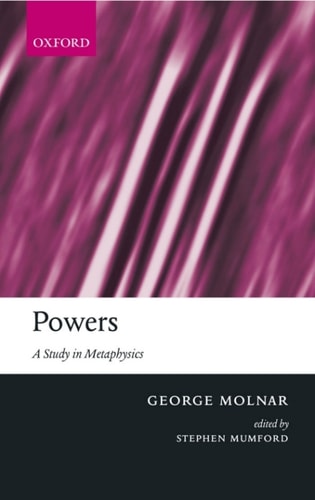
Powers: A Study in Metaphysics
0
0
As an Amazon Associate and affiliate partner, Menrva Books earns from qualifying purchases. Learn more
Author Description
George Molnar came to see that the solution to a number of the problems of contemporary philosophy lay in the development of an alternative to Hume's metaphysics. This alternative would have real causal powers at its centre. Molnar set about developing a thorough account of powers that might persuade those who remained, perhaps unknowingly, in the grip of Humean assumptions. He succeeded in producing something both highly focused and at the same time wide-ranging. He showed both that the notion of a power was central and that it could serve to dispel a number of long-standing philosophical problems. Molnar's account of powers is as realist as any that has so far appeared. He shows that dispositions are as real as any other properties. Specifically, they do not depend for their existence on their manifestations. Nevertheless, they are directed towards such manifestations. Molnar thus appropriates the notion of intentionality, from Brentano, and argues that it is the essential characteristic of powers. He offers a persuasive case for there being some basic and ungrounded powers, thus ruling out the reducibility of the dispositional to the non-dispositional. However, he does allow that there are non-power properties as well as power properties. In this respect, his final position is dualistic. This is contemporary metaphysics of the highest quality. It is a work that was almost complete when its author died. It has been edited for publication by another specialist in the subject, Stephen Mumford, who has also provided an introduction that will allow non-specialists to become acquainted with the issues. David Armstrong, one of the greatest living metaphysicians and personal friend of George Molnar, has provided a Foreword.
Menrva's Summary
THE THESIS
This work investigates the viability of a realist metaphysics centered on causal powers as a robust alternative to traditional Humean frameworks. George Molnar, a noted philosopher, argues that dispositions are fundamental properties that exist independently of their manifestations. By integrating the concept of intentionality into the study of powers, Molnar challenges the reductionist view that dispositional properties must be grounded in non-dispositional ones.
THE SCOPE MAP
What You Will Find
- A comprehensive realist account of causal powers and dispositions
- An analysis of the relationship between intentionality and physical properties
- A dualistic framework distinguishing between power and non-power properties
Scope Limits
- The text does not provide an exhaustive history of all metaphysical schools of thought
- It focuses primarily on the critique of Humean assumptions rather than broader theological or ethical implications
THE AUTHORITY PERSPECTIVE
Experts recognize this work as a significant contribution to contemporary metaphysics, particularly for its rigorous defense of dispositional realism. Readers frequently note the academic density of the prose, which is best suited for those with a background in analytic philosophy.
Page Count:
252
Publication Date:
2007-01-01
Publisher:
Clarendon Press
ISBN-10:
0191514012
ISBN-13:
9780191514012
Non-Fiction
Philosophy
Ontology
Academic
Metaphysics
Causation
Power Philosophy
Community Tags
Similar Books