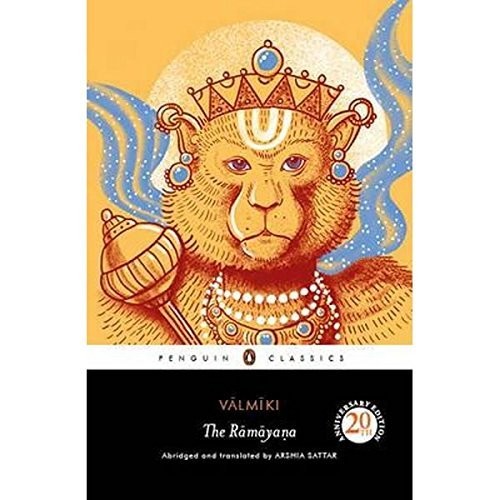
The Rāmāyaṇa
0
0
As an Amazon Associate and affiliate partner, Menrva Books earns from qualifying purchases. Learn more
Author Description
The Rāmāyaṇa is one of the two major Sanskrit epics of ancient India, the other being the Mahābhārata. It forms the Sanskrit Adikavya ('first poem'). The oldest and one of the most important poems of India, it is attributed to the sage Valmiki. The Rāmāyaṇa is a narrative of the struggles of the mythical prince Rama to retrieve his wife Sita from the demon king of Lanka, Ravana. The epic is composed of some 24,000 verses, divided into six Kanda (books). It is a work of immense cultural and religious significance in India and Southeast Asia.
Menrva's Summary
THE PULSE
The abduction of Sita by the demon king Ravana ignites a cosmic conflict between divine forces and demonic might. Valmiki's epic poem chronicles the righteous quest of Prince Rama, an avatar of Vishnu, to rescue his beloved wife Sita. Opposing Rama is the formidable Rakshasa king Ravana, whose ten heads symbolize his vast knowledge and power, and whose stronghold lies in the island kingdom of Lanka. Rama, aided by the loyal monkey general Hanuman and his Vanara army, must overcome immense obstacles, including crossing the ocean and battling Ravana's formidable forces, to achieve his goal and restore cosmic order. The narrative unfolds through a series of cantos, detailing Rama's exile, his alliance with the Vanaras, the construction of a bridge to Lanka, and the climactic war.
INSIDE THE PAGES
- The divine lineage and virtuous life of Prince Rama, heir to Ayodhya.
- Rama's fourteen-year exile to the Dandaka forest, accompanied by Sita and his brother Lakshmana.
- The abduction of Sita by Ravana, the Rakshasa king of Lanka.
- Rama's alliance with the Vanara king Sugriva and the pivotal role of Hanuman.
- The construction of the Setu (bridge) across the ocean to Lanka.
- The epic battle between Rama's army and Ravana's Rakshasa forces.
- The trial by fire (Agni Pariksha) to prove Sita's purity.
- Rama's return to Ayodhya and his subsequent reign as king.
THE COLLECTIVE ECHO
The Rāmāyaṇa is universally revered as one of the foundational epics of Indian literature and a cornerstone of Hindu tradition. Its narrative of dharma, duty, and devotion has resonated across millennia, influencing art, culture, and philosophy throughout South and Southeast Asia. Scholars and readers alike have long admired its intricate plot, profound philosophical underpinnings, and the enduring archetypes of its characters, particularly Rama, Sita, and Hanuman. The epic's exploration of moral complexities and the eternal struggle between good and evil continues to inspire contemplation and devotion.
Page Count:
696
Publication Date:
2000-01-01
ISBN-10:
0140298665
ISBN-13:
9780140298666
Poetry
Fiction
Classics
Indian
Epic Poetry
Mythology