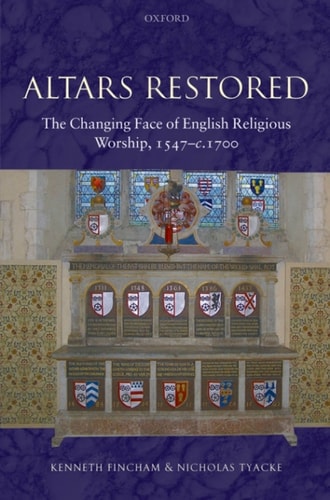
Altars Restored: The Changing Face of English Religious Worship, 1547-c.1700
0
0
As an Amazon Associate and affiliate partner, Menrva Books earns from qualifying purchases. Learn more
Author Description
Altars are powerful symbols, fraught with meaning, but during the early modern period they became a religious battleground. Attacked by reformers in the mid-sixteenth century because of their allegedly idolatrous associations with the Catholic sacrifice of the mass, a hundred years later they served to divide Protestants due to their re-introduction by Archbishop Laud and his associates as part of a counter-reforming programme. Moreover, having subsequently been removed by the victorious puritans, they gradually came back after the restoration of the monarchy in 1660. This book explores these developments, over a 150 year period, and recaptures the experience of the ordinary parishioner in this crucial period of religious change. Far from being the passive recipients of changes imposed from above, the laity are revealed as actively engaged from the early days of the Reformation, as zealous iconoclasts or their Catholic opponents - a division later translated into competing protestant views. Altars Restored integrates the worlds of theological debate, church politics and government, and parish practice and belief, which are often studied in isolation from one another. It draws from hitherto largely untapped sources, notably the surviving artefactual evidence comprising communion tables and rails, fonts, images in stained glass, paintings and plates, and examines the riches of local parish records - especially churchwardens' accounts. The result is a richly textured study of religious change at both local and national level.
Menrva's Summary
THE THESIS
This book investigates how the physical placement and symbolic function of altars served as a primary site of religious and political conflict in England between 1547 and 1700. Kenneth Fincham and Nicholas Tyacke, both established scholars of early modern English religion, utilize a synthesis of theological discourse, political history, and local parish records to argue that the laity were active participants in shaping religious practice rather than mere passive recipients of top-down mandates. By examining the tension between reformist iconoclasm and the Laudian re-introduction of communion rails, the authors demonstrate how material culture reflects the shifting landscape of Protestant identity.
THE SCOPE MAP
What You Will Find
- Analysis of the 150-year evolution of English church interiors and liturgical furniture.
- Examination of churchwardens' accounts and local parish records as primary data sources.
- Integration of theological debate with material evidence, including communion tables, rails, fonts, and stained glass.
Scope Limits
- The study focuses specifically on the English context and does not provide a comparative analysis of continental European altar controversies.
- The narrative concludes around 1700 and does not address the long-term liturgical developments of the eighteenth century.
THE AUTHORITY PERSPECTIVE
Historians and scholars of the Reformation frequently cite this work for its innovative use of material culture alongside traditional archival research. Readers often note the academic density of the prose, which provides a comprehensive view of how national religious policy manifested in the daily lives of local parishioners.
Page Count:
450
Publication Date:
2008-01-01
Publisher:
Oxford University Press
ISBN-10:
0191518719
ISBN-13:
9780191518713
History
Great Britain
European History
British History
Reformation
Cultural History
Religious History
History - Modern
Church History
Altars
Community Tags
Similar Books