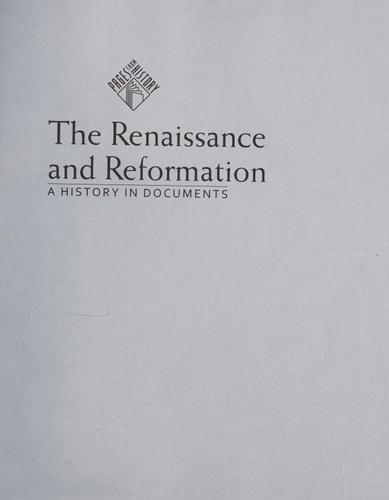
The Renaissance and Reformation: A History in Documents
0
0
As an Amazon Associate and affiliate partner, Menrva Books earns from qualifying purchases. Learn more
Author Description
At first glance, the Renaissance and the Reformation--two movements (one cultural, one religious) that defined Europe from 1400 to 1600--may appear to be polar opposites. The Renaissance found scholars and artists celebrating the beauty and splendor of the material world, while the Reformation saw Protestant and Catholic religious leaders and their followers focusing on eternal salvation. However, there were actually striking similarities between these two worlds. For instance, while both Renaissance artists and Reformation pastors originally desired a return to a "golden age" of the past, they both ended up creating something very new instead.In The Renaissance and Reformation, Merry Wiesner-Hanks allows the historical participants to tell their own stories. She presents a mix of visual sources and written documents not only from learned scholars, trained artists, university-educated religious reformers, and powerful political leaders--but also from more ordinary men and women. Leonardo da Vinci considers the merits of painting versus poetry in his notebook, while the Italian diplomat Baldassar Castiglione recommends the pastime of music-making to gentlemen in his book The Courtier. A group of small-time investors signs a contract for a trading venture from Genoa to Corsica and Sardinia, and a wealthy Florentine widow writes a letter to her son, weighing his ability to start a new business. A picture essay uses individual and family portraits to discuss ideas about personality, temperament, and "genius"; social differences in marital patterns; and changes in family relationships. Wiesner-Hanks places events in Europe in a global context, allowing readers to examine the ways in which they were related to the voyages of exploration.
Menrva's Summary
THE THESIS
This book investigates the interconnected nature of the Renaissance and the Reformation by examining how these two movements shaped European society between 1400 and 1600. Merry E. Wiesner-Hanks, a distinguished historian of early modern Europe, utilizes a primary-source-driven approach to challenge the perception that these movements were polar opposites. By curating a diverse collection of documents and visual artifacts, she argues that both movements shared a common impulse to reclaim a idealized past, which ultimately resulted in the creation of entirely new cultural and religious paradigms.
THE SCOPE MAP
What You Will Find
- Primary source documents including personal letters, business contracts, and diplomatic writings.
- Visual analysis of portraits and artistic works to interpret social temperament and family dynamics.
- A global context that links European developments to the era's voyages of exploration.
- Perspectives from both elite figures, such as Leonardo da Vinci, and ordinary citizens, including small-time investors and widows.
THE AUTHORITY PERSPECTIVE
Scholars and educators frequently cite this work as a valuable pedagogical tool for introducing students to the complexities of primary source analysis. The text is noted for its accessibility and its ability to humanize historical figures by balancing high-level political discourse with the everyday concerns of common people.
Page Count:
176
Publication Date:
2011-09-09
Publisher:
Oxford University Press
ISBN-10:
0195308891
ISBN-13:
9780195308891
History
Religious History
Reformation
European History
Renaissance
Cultural History
Community Tags
Similar Books