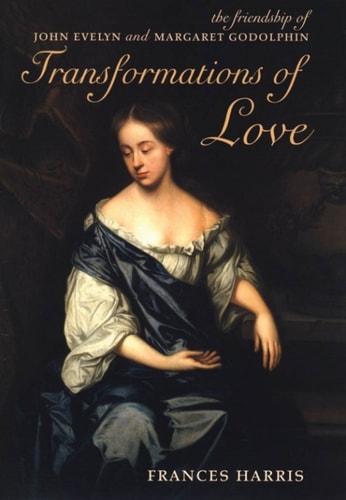
Transformations of Love: The Friendship of John Evelyn and Margaret Godolphin
0
0
As an Amazon Associate and affiliate partner, Menrva Books earns from qualifying purchases. Learn more
Author Description
The most controversial episode in the life of the seventeenth-century virtuoso and diarist John Evelyn has always been his passionate, complex friendship with the Restoration maid of honour Margaret Blagge, afterwards Mrs Godolphin. His 'Life of Mrs Godolphin', written after her early death in childbirth, exalted the friendship and represented her as effectively a saint. They saw their intense friendship as platonic spiritual mentoring. Yet it is sometimes argued that what took place between them was actually a kind of seduction on Evelyn's part; that far from trying to overcome her religious scruples about marriage to a young man she deeply loved, as he afterwards claimed, he secretly encouraged them in order to keep her in his power, and even falsified some documents to conceal this from her husband, whose patronage he sought. Was Evelyn in his way as much a sexual predator as the Restoration rakes he professed to despise, or does the episode provide a window on an unexplored aspect of early modern spirituality? Undoubtedly there was more to the friendship than Evelyn publicly admitted, but it remains a puzzle still to be interpreted. This new study is based on Evelyn's papers, now fully accessible for the first time, and on important and hitherto unknown correspondence between Margaret Blagge and her future husband. It situates the episode fully within the pre- and post-Reformation debates concerning marriage and friendship (the latter seen by some as 'more a sacrament' than marriage) and the long traditions of platonic love and intense friendships between men and women in religious contexts. Its diverse and vividly realized settings include the glamorous, disreputable public household of the Restoration court and the great gardens of the day, at once 'little worlds' in microcosm and recreations of paradise on earth.
Menrva's Summary
THE THESIS
This study investigates the ambiguous nature of the relationship between seventeenth-century diarist John Evelyn and Margaret Godolphin, questioning whether their bond was a genuine spiritual mentorship or a calculated manipulation by Evelyn. Frances Harris, a scholar of the period, utilizes newly accessible personal papers and previously unknown correspondence to re-examine the historical record. The book challenges the traditional hagiographic portrayal of the friendship by situating it within the complex religious and social debates of the Restoration era regarding marriage, platonic love, and gender dynamics.
THE SCOPE MAP
What You Will Find
- Analysis of the Restoration court environment and its social hierarchies.
- Examination of seventeenth-century theological debates concerning marriage and friendship.
- Integration of primary source documents, including private correspondence and Evelyn's own writings.
Scope Limits
- The study does not provide a definitive psychological diagnosis of Evelyn's motivations.
- It does not attempt to cover the entirety of Evelyn's life, focusing specifically on the period of his association with Margaret Godolphin.
THE AUTHORITY PERSPECTIVE
Scholars and historians recognize this work as a significant contribution to the study of early modern social and religious life. The text is noted for its meticulous use of archival material to provide a nuanced perspective on a previously misunderstood historical relationship.
Page Count:
344
Publication Date:
2004-01-01
Publisher:
Oxford University Press
ISBN-10:
0191514411
ISBN-13:
9780191514418
History
Biography
Women biography
England
Seventeenth Century
Social History
English & College Success
English
Great Britain
Literary Criticism
British History
Authors biography
Man-woman relationships
Community Tags
Similar Books