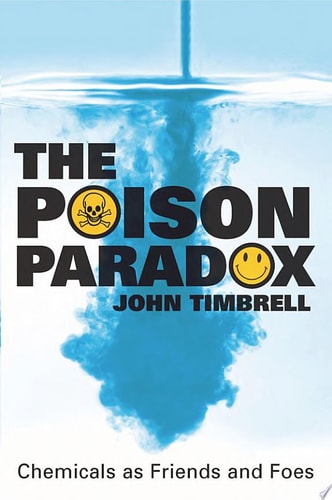
The Poison Paradox: Chemicals As Friends And Foes
0
0
As an Amazon Associate and affiliate partner, Menrva Books earns from qualifying purchases. Learn more
Author Description
Every Day We Are Surrounded By Chemicals That Are Potentially Harmful. Some Of These We Take Intentionally In The Form Of Drugs; Some We Take Unknowingly Through The Food We Eat, And The Environment Around Us. John Timbrell Explores What Makes Particular Chemicals Harmful, What Their Effects Are, And How We Can Test For Them. He Examines Drugs Such As Paracetamol And What It Does To The Body; Ricin, The Most Toxic Substance Known To Man; Paraquat, A Widely Available Weedkiller; And How The Puffer Fish, Eaten As A Delicacy In Japan, Can Kill. Using Case Studies From All Around The World, Such As The Spanish Oil Syndrome Which Made Over 20,000 People Ill In Madrid, Timbrell Uncovers The Facts Behind Chemical Scares. He Shows How, With A Rational, Scientific, And Balanced Approach, Risks Can Be Assessed And Managed Safely.
Menrva's Summary
THE THESIS
This book investigates the fundamental question of how chemical substances function as both essential tools and lethal threats within human environments. John Timbrell, a professor of toxicology, utilizes his extensive academic background to demystify the science of poisons. He presents a framework for understanding chemical risk assessment, arguing that toxicity is often a matter of dosage and context rather than inherent evil. By analyzing historical incidents and biological mechanisms, he provides a rational approach to evaluating the chemicals we encounter daily.
THE SCOPE MAP
What You Will Find
- Analysis of common substances including pharmaceuticals like paracetamol and environmental toxins like paraquat.
- Examination of biological toxins found in nature, such as those in the puffer fish.
- Historical case studies including the Spanish Oil Syndrome.
- Methodologies for testing chemical toxicity and managing public health risks.
Scope Limits
- The text does not provide an exhaustive encyclopedia of every known chemical compound.
- It does not offer medical advice for individual poisoning cases or specific clinical treatments.
THE AUTHORITY PERSPECTIVE
Experts and readers alike recognize this work as an accessible introduction to the principles of toxicology for a general audience. The prose is noted for its clarity, effectively balancing scientific rigor with practical explanations of complex chemical interactions.
Page Count:
368
Publication Date:
2005-01-01
Publisher:
Oup Oxford
ISBN-10:
0191513040
ISBN-13:
9780191513046
Science
Non-Fiction
Public Health
Chemistry
Toxicology