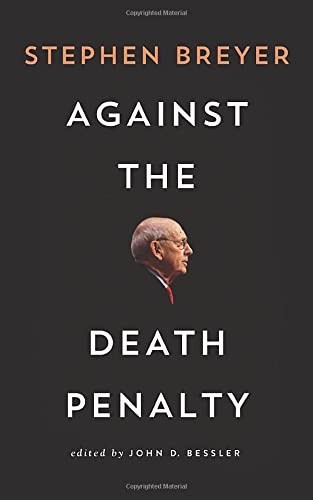
Against the Death Penalty
0
0
As an Amazon Associate and affiliate partner, Menrva Books earns from qualifying purchases. Learn more
Author Description
A landmark dissenting opinion arguing against the death penalty. Does the death penalty violate the Constitution? In Against the Death Penalty, Justice Stephen G. Breyer argues that it does: that it is carried out unfairly and inconsistently, and thus violates the ban on "cruel and unusual punishments" specified by the Eighth Amendment to the Constitution. "Today's administration of the death penalty," Breyer writes, "involves three fundamental constitutional defects: (1) serious unreliability, (2) arbitrariness in application, and (3) unconscionably long delays that undermine the death penalty's penological purpose. Perhaps as a result, (4) most places within the United States have abandoned its use." This volume contains Breyer's dissent in the case of Glossip v. Gross, which involved an unsuccessful challenge to Oklahoma's use of a lethal-injection drug because it might cause severe pain. Justice Breyer's legal citations have been edited to make them understandable to a general audience, but the text retains the full force of his powerful argument that the time has come for the Supreme Court to revisit the constitutionality of the death penalty. Breyer was joined in his dissent from the bench by Justice Ruth Bader Ginsburg. Their passionate argument has been cited by many legal experts - including fellow Justice Antonin Scalia - as signaling an eventual Court ruling striking down the death penalty. A similar dissent in 1963 by Breyer's mentor, Justice Arthur J. Goldberg, helped set the stage for a later ruling, imposing what turned out to be a four-year moratorium on executions
Menrva's Summary
THE THESIS
The death penalty, as currently administered in the United States, is unconstitutional. In Against the Death Penalty, Justice Stephen G. Breyer presents a powerful legal argument that the death penalty violates the Eighth Amendment's prohibition against cruel and unusual punishments. He details fundamental constitutional defects including serious unreliability, arbitrariness in application, and unconscionably long delays that negate its intended purpose. Breyer's dissent, originally delivered in the case of Glossip v. Gross, is presented here with edited legal citations for a general audience, advocating for a Supreme Court reconsideration of the death penalty's constitutionality.
THE SCOPE MAP
- Analysis of the Eighth Amendment's ban on "cruel and unusual punishments" in relation to capital punishment.
- Detailed examination of three core constitutional defects: unreliability, arbitrariness, and excessive delays.
- Discussion of the declining use of the death penalty across the United States.
- Contextualization within the Supreme Court case Glossip v. Gross concerning lethal-injection drugs.
- Edited legal citations to make complex legal arguments accessible to a general readership.
- The historical precedent of Justice Arthur J. Goldberg's dissent in 1963, which preceded a moratorium on executions.
THE AUTHORITY PERSPECTIVE
Justice Breyer's dissent, as presented in this volume, has been recognized by legal experts as a significant argument against the death penalty's constitutionality. The text retains the full force of his reasoning, highlighting issues of unreliability, arbitrariness, and undue delay in its application. Its inclusion of edited legal citations aims to make this critical legal perspective accessible to a broader audience. The work is seen by some as potentially influencing future Court decisions on capital punishment, drawing parallels to past dissents that preceded significant legal shifts.
Page Count:
162
Publication Date:
2016-01-01
ISBN-10:
0815728891
ISBN-13:
9780815728894
Politics
Science
Non-Fiction
Law
Social Issues
Community Tags
Similar Books