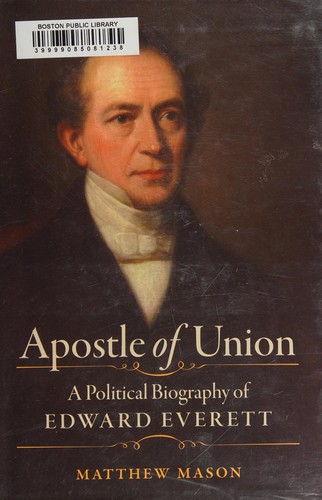
Apostle of Union
0
0
As an Amazon Associate and affiliate partner, Menrva Books earns from qualifying purchases. Learn more
Author Description
Known today as "the other speaker at Gettysburg," Edward Everett had a distinguished and illustrative career at every level of American politics from the 1820s through the Civil War. In this new biography, Matthew Mason argues that Everett's extraordinarily well-documented career reveals a complex man whose shifting political opinions, especially on the topic of slavery, illuminate the nuances of Northern Unionism. In the case of Everett--who once pledged to march south to aid slaveholders in putting down slave insurrections--Mason explores just how complex the question of slavery was for most Northerners, who considered slavery within a larger context of competing priorities that alternately furthered or hindered antislavery actions. By charting Everett's changing stance toward slavery over time, Mason sheds new light on antebellum conservative politics, the complexities of slavery and its related issues for reform-minded Americans, and the ways in which secession turned into civil war. As Mason demonstrates, Everett's political and cultural efforts to preserve the Union, and the response to his work from citizens and politicians, help us see the coming of the Civil War as a three-sided, not just two-sided, contest.
Menrva's Summary
THE THESIS
Edward Everett's career serves as a lens through which to understand the complexities of Northern Unionism and the evolving stance on slavery in antebellum America. Matthew Mason's biography examines Edward Everett, a prominent figure in American politics from the 1820s to the Civil War, whose career reveals a man of shifting opinions, particularly concerning slavery. Mason argues that Everett's documented political evolution, including his past pledge to aid slaveholders, highlights the nuanced perspective of many Northerners who viewed slavery within a broader context of competing priorities. The book charts Everett's changing views on slavery, offering insights into conservative antebellum politics, the multifaceted nature of slavery for reform-minded Americans, and the path to the Civil War as a contest involving more than just two sides.
THE SCOPE MAP
- A detailed examination of Edward Everett's political career from the 1820s through the Civil War.
- Analysis of Everett's evolving opinions on slavery and their implications for Northern Unionism.
- Exploration of how Northerners balanced concerns about slavery with other political priorities.
- Insights into antebellum conservative politics and reform movements.
- An argument for viewing the coming of the Civil War as a three-sided contest.
THE AUTHORITY PERSPECTIVE
Matthew Mason's biography of Edward Everett is positioned as a significant contribution to understanding the complexities of the Civil War era. The book's focus on Everett's nuanced views on slavery and Unionism aims to shed new light on antebellum politics. By analyzing Everett's career, the work seeks to offer a more intricate perspective on the motivations and conflicts that led to the war. The reception, as suggested by the description, likely centers on its detailed historical analysis and its re-evaluation of a key, though often overlooked, political figure.
Page Count:
434
Publication Date:
2016-01-01
ISBN-10:
1469628600
ISBN-13:
9781469628608
History
Biography
Politics
Non-Fiction
Community Tags
Similar Books














