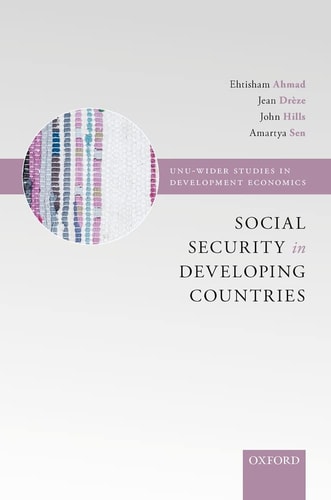
Social Security in Developing Countries
0
0
As an Amazon Associate and affiliate partner, Menrva Books earns from qualifying purchases. Learn more
Author Description
The term "social security" has a very different meaning in underdeveloped countries -- whose populations live in great insecurity -- and is best understood as poverty alleviation. This book attempts to define social security in the Third World and to examine what sort of programs are most suitable for developing countries. The authors review current literature on the subject. Some chapters explore broad themes, others contain case studies describing social security provisions in various regions of Asia, Latin America, and Southern Africa. This illuminating study will be of interest to development economists as well as those working in international organizations concerned with policy-making in the Third World and management of resources.
Menrva's Summary
THE THESIS
This book investigates the definition and implementation of social security programs specifically tailored to the economic realities of developing nations. The authors, including Nobel laureate Amartya Sen, utilize a combination of theoretical frameworks and empirical case studies to argue that social security in the Third World must be conceptualized primarily as a mechanism for poverty alleviation rather than as a replication of Western welfare models. By analyzing diverse regional contexts, the text provides a structured approach for policymakers to manage resources effectively in environments characterized by high levels of insecurity.
THE SCOPE MAP
What You Will Find
- Comparative analysis of social security frameworks across Asia, Latin America, and Southern Africa.
- Methodological approaches to defining poverty alleviation in underdeveloped economic systems.
- Case studies detailing specific regional policy successes and failures.
- Policy recommendations for international organizations and government planners.
THE AUTHORITY PERSPECTIVE
Experts recognize this work as a foundational text for understanding the intersection of welfare economics and development policy. Readers frequently note the academic rigor and the clarity with which the authors bridge theoretical economic concepts with practical, on-the-ground policy challenges.
Page Count:
496
Publication Date:
1991-04-11
Publisher:
Clarendon Press
ISBN-10:
0198233000
ISBN-13:
9780198233008
Economics
Social policy
Poverty
International relations
Developing Countries