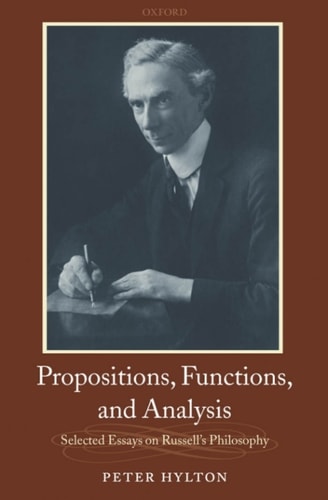
Propositions, Functions, and Analysis: Selected Essays on Russell's Philosophy
0
0
As an Amazon Associate and affiliate partner, Menrva Books earns from qualifying purchases. Learn more
Author Description
The work of Bertrand Russell had a decisive influence on the emergence of analytic philosophy, and on its subsequent development. The essays collected in this volume, by one of the leading authorities on Russell's philosophy, all aim at recapturing and articulating aspects of Russell's philosophical vision during his most influential and important period, the two decades following his break with Idealism in 1899. One theme of the collection concerns Russell's views about propositions and their analysis, and the relation of those ideas to his rejection of Idealism. Another theme is the development of Russell's logicism, culminating in Whitehead's and Russell's Principia Mathematica, and Hylton offers a revealing view of the conception of logic which underlies it. Here again there is an emphasis on Russell's argument against Idealism, on the idea that his logicism was a crucial part of that argument. A further focus of the volume is Russell's views about functions and propositional functions. This theme is part of a contrast that Hylton draws between Russell's general philosophical position and that of Frege; in particular, there is a close parallel with the quite different views that the two philosophers held about the nature of philosophical analysis. Hylton also sheds valuable light on the much-disputed idea of an operation, which Wittgenstein advances in the Tractatus Logico-Philosophicus.
Menrva's Summary
THE THESIS
This collection investigates the foundational philosophical vision of Bertrand Russell during his most influential period, specifically examining how his logicism and analysis of propositions served as a rejection of Idealism. Peter Hylton, a recognized authority on Russellian thought, synthesizes two decades of scholarship to clarify the logical framework that underpinned the development of analytic philosophy. By analyzing the transition from Russell's break with Idealism to the publication of Principia Mathematica, the author provides a rigorous examination of the intellectual shifts that defined early twentieth-century logic.
THE SCOPE MAP
What You Will Find
- Analysis of Russell's rejection of Idealism post-1899
- Detailed examination of logicism and the conceptual foundations of Principia Mathematica
- Comparative study of Russell and Frege regarding the nature of philosophical analysis
- Investigation into the concept of operations as presented in Wittgenstein's Tractatus Logico-Philosophicus
Scope Limits
- The volume focuses primarily on the two decades following 1899 and does not provide a comprehensive biography of Russell's entire career
- It does not attempt to resolve all contemporary debates in logic, focusing instead on historical and philosophical reconstruction
THE AUTHORITY PERSPECTIVE
Scholars and students of analytic philosophy frequently cite this collection as a primary resource for understanding the technical and historical nuances of Russell's early work. Experts highlight the text's academic density and its success in clarifying the complex relationship between Russell's logic and his broader philosophical objectives.
Page Count:
240
Publication Date:
2008-01-01
Publisher:
Oxford University Press
ISBN-10:
0191515965
ISBN-13:
9780191515965
Philosophy
Philosophy history
Epistemology
History & Surveys
Logic
Community Tags
Similar Books