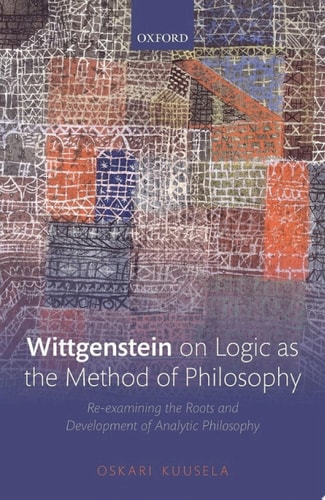
Wittgenstein on Logic as the Method of Philosophy: Re-examining the Roots and Development of Analytic Philosophy
0
0
As an Amazon Associate and affiliate partner, Menrva Books earns from qualifying purchases. Learn more
Author Description
In Wittgenstein on Logic as the Method of Philosophy, Oskari Kuusela examines Wittgenstein's early and late philosophies of logic, situating their philosophical significance in early and middle analytic philosophy with particular reference to Frege, Russell, Carnap, and Strawson. He argues that not only the early but also the later Wittgenstein sought to further develop the logical-philosophical approaches of his contemporaries. Throughout his career Wittgenstein's aim was to resolve problems with and address the limitations of Frege's and Russell's accounts of logic and their logical methodologies so as to achieve the philosophical progress that originally motivated the logical-philosophical approach. By re-examining the roots and development of analytic philosophy, Kuusela seeks to open up covered up paths for the further development of analytic philosophy. Offering a novel interpretation of the philosopher, he explains how Wittgenstein extends logical methodology beyond calculus-based logical methods and how his novel account of the status of logic enables one to do justice to the complexity and richness of language use and thought while retaining rigour and ideals of logic such as simplicity and exactness. In addition, this volume outlines the new kind of non-empiricist naturalism developed in Wittgenstein's later work and explaining how his account of logic can be used to dissolve the long-standing methodological dispute between the ideal and ordinary language schools of analytic philosophy. It is of interest to scholars, researchers, and advance students of philosophy interested in engaging with a number of scholarly debates.
Menrva's Summary
THE THESIS
This book investigates the continuity of Ludwig Wittgenstein’s logical methodology and its role in shaping the trajectory of analytic philosophy. Oskari Kuusela, a scholar specializing in Wittgensteinian thought, argues that Wittgenstein’s career-long project was to refine and extend the logical methodologies established by Frege and Russell. By analyzing the transition from early to late Wittgenstein, the author posits that Wittgenstein’s work provides a framework to resolve methodological conflicts between ideal and ordinary language schools of philosophy.
THE SCOPE MAP
What You Will Find
- Comparative analysis of Wittgenstein’s work alongside Frege, Russell, Carnap, and Strawson
- A detailed examination of non-empiricist naturalism in later Wittgensteinian thought
- Methodological frameworks for reconciling ideal language and ordinary language philosophy
Scope Limits
- The text does not provide a general biography of Wittgenstein’s life outside of his philosophical development
- It does not serve as an introductory primer for readers unfamiliar with formal logic or analytic philosophy
THE AUTHORITY PERSPECTIVE
Scholars and researchers in the field of analytic philosophy frequently note the high academic density and rigorous argumentation present throughout the text. Experts highlight this work as a significant contribution to the ongoing debate regarding the evolution of logical methodology in the twentieth century.
Page Count:
311
Publication Date:
2018-01-01
Publisher:
OUP Oxford
ISBN-10:
019256532X
ISBN-13:
9780192565327
Philosophy
Philosophy of
Logic
History & Surveys
Epistemology
Community Tags
Similar Books