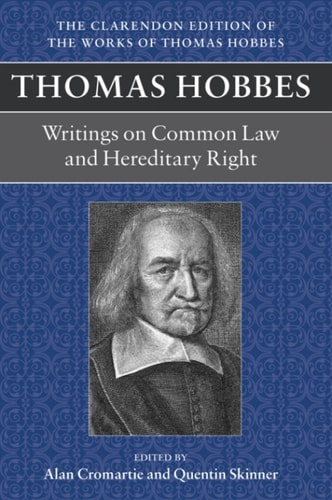
Thomas Hobbes: Writings on Common Law & Hereditary Right
0
0
As an Amazon Associate and affiliate partner, Menrva Books earns from qualifying purchases. Learn more
Author Description
This volume in the Clarendon Edition of the Works of Thomas Hobbes contains A dialogue between a philosopher and a student, of the common laws of England, edited by Alan Cromartie, supplemented by the important fragment on the issue of regal succession, 'Questions relative to Hereditary Right', discovered and edited by Quentin Skinner. The former work is the last of Hobbes's major political writings. As a critique of common law by a great philosopher, it should be essential reading for anybody interested in English political thought or legal theory. Although it was written when Hobbes was at least eighty, it is a lively piece of work that goes beyond a recapitulation of earlier Hobbesian doctrines, not least in applying his central ideas to the details of the English constitution. This edition supplies the extensive annotation on matters of legal and historical detail that is required by non-specialist readers; it also assists students by offering cross-references to other treatises. Cromartie's introduction is an authoritative account of seventeenth-century thinking about the common law and of Hobbes's shifting attitudes towards it. It has often been suspected that the book was motivated by fear of being burned for heresy. Cromartie disentangles the complex evidence (scattered across a number of late works) that documents this fear's development, and shows why the philosopher's acute anxieties eventually led him to write a legal treatise. In clarifying these questions, the edition casts fresh light upon his attitude to law and sovereignty. The second piece takes the form of a question put to Hobbes about the right of succession under hereditary monarchies, together with Hobbes's response. The question is in the handwriting of the fourth Earl of Devonshire, the son of the third Earl, whom Hobbes had tutored in the 1630s. He asks Hobbes whether an heir can be excluded if he is incapable of protecting his prospective subjects. The question of 'exclusion' became the mo
Menrva's Summary
THE THESIS
This volume investigates the intersection of common law, sovereignty, and hereditary succession within the political framework of seventeenth-century England. The text presents the final major political writings of Thomas Hobbes, edited by Alan Cromartie and Quentin Skinner, to examine how Hobbes applied his philosophical doctrines to the specific legal and constitutional structures of his time. By contextualizing these works within the political anxieties of the era, the editors provide a framework for understanding Hobbes's evolving stance on the legitimacy of monarchical authority.
THE SCOPE MAP
What You Will Find
- A critical edition of 'A Dialogue between a Philosopher and a Student, of the Common Laws of England'.
- The 'Questions relative to Hereditary Right' fragment regarding royal succession.
- Extensive historical and legal annotations for non-specialist readers.
- Scholarly analysis of Hobbes's motivations, including his concerns regarding heresy and political persecution.
Scope Limits
- The volume does not provide a comprehensive biography of Hobbes beyond his late-life legal and political activities.
- It does not cover the entirety of Hobbes's earlier philosophical works, focusing primarily on his late-career legal treatises.
THE AUTHORITY PERSPECTIVE
Scholars and historians regard this edition as a definitive resource for understanding the late political thought of Thomas Hobbes. Readers frequently note the academic density of the prose, which is balanced by the editors' thorough contextualization of seventeenth-century legal debates.
Page Count:
272
Publication Date:
2008-01-01
Publisher:
Oxford University Press
ISBN-10:
0191513474
ISBN-13:
9780191513473
History
Philosophy
English
17th Century
Law
Linguistics
English & College Success
Professional Career & Trade
History & Surveys
Existentialism
Legal Theory
Community Tags
Similar Books