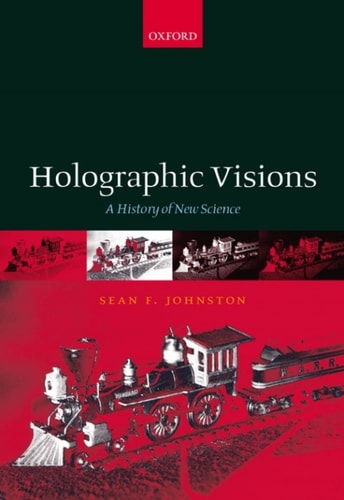
Holographic Visions: A History of New Science
0
0
As an Amazon Associate and affiliate partner, Menrva Books earns from qualifying purchases. Learn more
Author Description
Holography exploded on the scientific world in 1964, but its slow fuse had been burning much longer. Over the next four decades, the echoes of that explosion reached scientists, engineers, artists and popular culture. Emerging from classified military research, holography evolved to represent the power of post-war physics, an aesthetic union of art and science, the countercultural meanderings of holism, a cottage industry for waves of would-be entrepreneurs and a fertile plot device for science fiction. New working cultures sprang up to mutate holography, redefining its products, reshaping its audiences and reconceiving its applications. The outcomes included ever more sublime holograms and exquisitely sensitive measuring techniques - but also priority disputes, prurience and poisonous business rivalries. New subjects cross intellectual borders, and so do their explanations. This book draws on the history and philosophy of science and technology, social studies, politics and cultural history to trace the trajectory of holography. The result is an in-depth account of how new science emerges. Based on unprecedented interviews with pioneer holographers and extensive archival research, it reveals how science, technology, art and wider culture are entwined in the modern world.
Menrva's Summary
THE THESIS
This book investigates the complex emergence and evolution of holography from its classified military origins to its diverse applications in art, science, and popular culture. Author Sean F. Johnston, a historian of science and technology, utilizes extensive archival research and original interviews with pioneer holographers to construct a multi-disciplinary framework. He argues that the development of new science is not a linear progression but a messy, social process shaped by competing interests, cultural trends, and institutional rivalries.
THE SCOPE MAP
What You Will Find
- A detailed historical timeline of holography from 1964 through the subsequent four decades.
- Analysis of the intersection between post-war physics, countercultural movements, and commercial entrepreneurship.
- Examination of the social and political dynamics within scientific research communities.
Scope Limits
- The text does not provide a technical manual for creating holograms.
- It does not focus exclusively on the physics of light, but rather on the social history of the technology.
THE AUTHORITY PERSPECTIVE
Experts recognize this work as a comprehensive study of how scientific innovations are shaped by their broader cultural and social environments. Readers frequently note the academic density of the prose, which provides a rigorous examination of the subject for historians and scientists alike.
Page Count:
544
Publication Date:
2006-01-01
Publisher:
OUP Oxford
ISBN-10:
0191513881
ISBN-13:
9780191513886
Physics
Science History
Holography
Philosophy of
Trades & Technology
Cultural History
Technology
Technology & Engineering
Community Tags
Similar Books