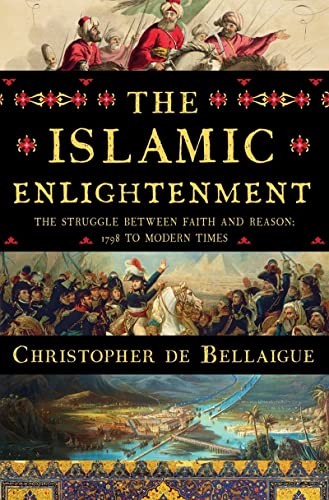
The Islamic Enlightenment
0
0
As an Amazon Associate and affiliate partner, Menrva Books earns from qualifying purchases. Learn more
Author Description
A revelatory and game-changing narrative that rewrites everything we thought we knew about the modern history of the Islamic world. With majestic prose, Christopher de Bellaigue presents an absorbing account of the political and social reformations that transformed the lands of Islam in the nineteenth and early twentieth centuries. Flying in the face of everything we thought we knew, The Islamic Enlightenment becomes an astonishing and revelatory history that offers a game-changing assessment of the Middle East since the Napoleonic Wars. Beginning his account in 1798, de Bellaigue demonstrates how Middle Eastern heartlands have long welcomed modern ideals and practices, including the adoption of modern medicine, the emergence of women from seclusion, and the development of democracy. With trenchant political and historical insight, de Bellaigue further shows how the violence of an infinitesimally small minority is in fact the tragic blowback from these modernizing processes. What makes The Islamic Enlightenment particularly germane is that non-Muslim pundits in the post-9/11 era have repeatedly called for Islam to subject itself to the transformations that the West has already achieved since the Enlightenment--the absurd implication being that if Muslims do not stop reading or following the tenets of the Qur'an and other holy books, they will never emerge from a benighted state of backwardness. The Islamic Enlightenment, with its revolutionary argument, completely refutes this view and, in the process, reveals the folly of Westerners demanding modernity from those whose lives are already drenched in it.
Menrva's Summary
THE THESIS
The Islamic Enlightenment investigates the profound political and social transformations that reshaped the Islamic world during the nineteenth and early twentieth centuries.
THE SCOPE MAP
- An examination of the adoption of modern ideals and practices in Middle Eastern heartlands since 1798.
- Analysis of the emergence of women from seclusion and the development of democratic ideas.
- Exploration of the connection between modernizing processes and subsequent violence.
- A refutation of the notion that Islamic societies have resisted modernity.
- Insight into the historical context of Western assumptions about Islamic backwardness.
THE AUTHORITY PERSPECTIVE
The book is presented as a revelatory narrative that challenges conventional understandings of the modern Islamic world. Its argument that Middle Eastern societies have long embraced modern ideals, including medicine and democracy, directly counters the idea that Islam is inherently resistant to progress. The author's analysis suggests that contemporary violence is a tragic consequence of these very modernizing processes, reframing the historical relationship between the Islamic world and modernity. This perspective aims to correct the 'absurd implication' that Muslims must abandon their faith to achieve modernity.
Page Count:
398
Publication Date:
2017-01-01
ISBN-10:
0871403730
ISBN-13:
9780871403735
Non-Fiction
History
Islamic History
Middle East
Modern History
Community Tags
Similar Books