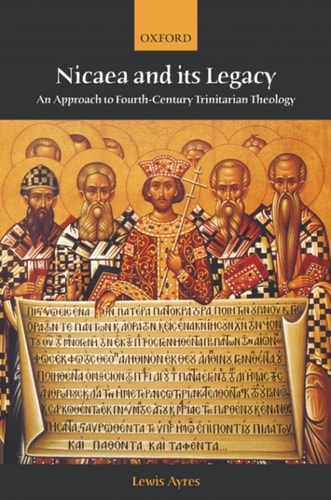
Nicaea and Its Legacy: An Approach to Fourth-Century Trinitarian Theology
0
0
As an Amazon Associate and affiliate partner, Menrva Books earns from qualifying purchases. Learn more
Author Description
The first part of Nicaea and its Legacy offers a narrative of the fourth-century trinitarian controversy. It does not assume that the controversy begins with Arius, but with tensions among existing theological strategies. Lewis Ayres argues that, just as we cannot speak of one `Arian' theology, so we cannot speak of one `Nicene' theology either, in 325 or in 381. The second part of the book offers an account of the theological practices and assumptions within which pro-Nicene theologians assumed their short formulae and creeds were to be understood. Ayres also argues that there is no fundamental division between eastern and western trinitarian theologies at the end of the fourth century. The last section of the book challenges modern post-Hegelian trinitarian theology to engage with Nicaea more deeply.
Menrva's Summary
THE THESIS
This work investigates the complex development of fourth-century Trinitarian theology by challenging traditional narratives regarding the Nicene and Arian controversies. Lewis Ayres, a scholar of early Christian history, utilizes a rigorous examination of primary source texts to argue that neither 'Arian' nor 'Nicene' theology existed as a monolithic entity during this period. By analyzing the theological practices and assumptions of pro-Nicene thinkers, he demonstrates that the division between eastern and western theological traditions was far less pronounced than modern scholarship often suggests.
THE SCOPE MAP
What You Will Find
- A detailed historical narrative of the fourth-century Trinitarian controversy.
- An analysis of the theological practices and linguistic assumptions underlying early creeds.
- A critical evaluation of the relationship between eastern and western theological developments.
- A challenge to contemporary post-Hegelian interpretations of Trinitarian doctrine.
Scope Limits
- The text does not provide a comprehensive history of the entire fourth century, focusing specifically on Trinitarian theological discourse.
- It does not attempt to reconcile all modern theological debates, focusing instead on the historical context of the Nicene era.
THE AUTHORITY PERSPECTIVE
Scholars and theologians frequently cite this work as a foundational text for understanding the nuances of fourth-century patristic thought. Readers often note the academic density of the prose, which requires a significant background in historical theology to fully navigate.
Page Count:
475
Publication Date:
2006-01-01
Publisher:
Oxford University Press
ISBN-10:
0191525006
ISBN-13:
9780191525001
History
Religion
Patristics
Church History
Theology
Trinity
Christianity
Community Tags
Similar Books