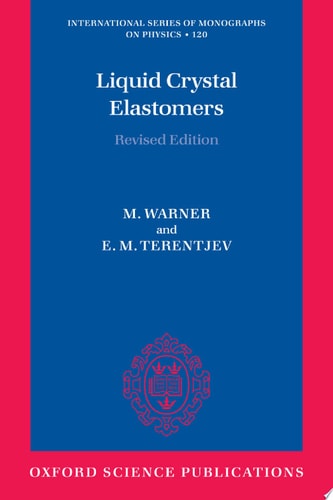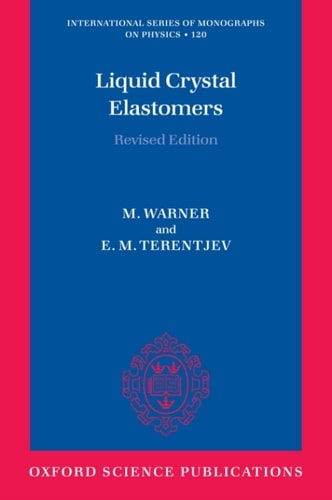
Liquid Crystal Elastomers
0
0
As an Amazon Associate and affiliate partner, Menrva Books earns from qualifying purchases. Learn more
Author Description
Liquid crystals are fluids with a directionality defined. Polymers are long molecules with a shape that can be changed. As a network, polymers form rubber - a soft solid that is locally liquid-like and capable of huge extension. Liquid crystal elastomers are a combination of all these curious aspects, but with additional, revolutionary new phenomena - for example, spontaneous shape changes of several hundred percent induced by temperature change, with equally large opto-mechanical responses, shape change without energy cost ("soft elasticity"), colour change with strain, lasing and photonics, sensitivity to molecular handedness and soft solid ferroelectricity. This book is a primer for liquid crystals, polymers, rubber, and elasticity. It then describes the theory and experiment of these remarkable materials for the first time as a monograph. Worked examples are solved so that the reader can become proficient in the field himself. The book is directed at physicists, chemists, material scientists, engineers and applied mathematicians at the graduate student level and beyond
Menrva's Summary
THE THESIS
This monograph investigates the physical properties and mechanical behaviors of liquid crystal elastomers, a class of materials that combine the fluid directionality of liquid crystals with the network structure of rubber. Authors Eugene M. Terentjev and Mark Warner, both established researchers in the field of soft matter physics, synthesize theoretical frameworks and experimental data to explain phenomena such as soft elasticity, opto-mechanical responses, and spontaneous shape changes. The text serves as both an introductory primer and a comprehensive reference for the underlying mechanics of these materials.
THE SCOPE MAP
What You Will Find
- Theoretical foundations of liquid crystals, polymers, and rubber elasticity
- Analysis of soft elasticity and large-scale shape changes
- Discussion of opto-mechanical responses, photonics, and ferroelectricity
- Worked examples for practical application and problem-solving
Scope Limits
- The text assumes a background in physics or chemistry at the graduate level
- It does not cover basic undergraduate-level introductory physics concepts
THE AUTHORITY PERSPECTIVE
Experts recognize this work as a foundational monograph for researchers and graduate students entering the field of soft matter. Readers frequently note the technical density of the prose, which is intended for an audience of physicists, chemists, and engineers.
Page Count:
424
Publication Date:
2003-01-01
Publisher:
OUP Oxford
ISBN-10:
0191523631
ISBN-13:
9780191523632
Earth Sciences
Physics
Polymers
Engineering
Chemistry