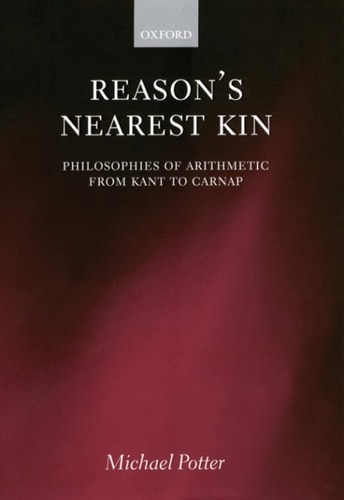
Reason's Nearest Kin: Philosophies of Arithmetic from Kant to Carnap
0
0
As an Amazon Associate and affiliate partner, Menrva Books earns from qualifying purchases. Learn more
Author Description
How do we account for the truth of arithmetic? And if it does not depend for its truth on the way the world is, what constrains the world to conform to arithmetic? Reason's Nearest Kin is a critical examination of the astonishing progress made towards answering these questions from the late nineteenth to the mid-twentieth century. In the space of fifty years Frege, Dedekind, Russell, Wittgenstein, Ramsey, Hilbert, and Carnap developed accounts of the content of arithmetic that were brilliantly original both technically and philosophically. Michael Potter's innovative study presents them all as finding that content in various aspects of the complex linkage between experience, language, thought, and the world. Potter's reading places them all in Kant's shadow since it was his attempt to ground arithmetic in the spatio-temporal structure of reality that they were reacting against; but it places us in Gödel's shadow since his incompleteness theorems supply us with a measure of the richness of the content they were trying to explain. This stimulating reassessment of some of the classic texts in the philosophy of mathematics reveals many unexpected connections and illuminating comparisons, and offers a wealth of ideas for future work in the subject.
Menrva's Summary
THE THESIS
This book investigates the philosophical foundations of arithmetic and the nature of its truth by examining the evolution of mathematical logic from the late nineteenth to the mid-twentieth century. Michael D. Potter, a scholar of philosophy and mathematics, analyzes the work of major figures including Frege, Dedekind, Russell, and Carnap. He argues that these thinkers were collectively responding to the Kantian framework regarding the relationship between arithmetic and the structure of reality, while simultaneously evaluating their contributions against the backdrop of Gödel's incompleteness theorems.
THE SCOPE MAP
What You Will Find
- A comparative analysis of mathematical philosophies from the late 1800s to the mid-1900s.
- An examination of the interplay between language, thought, and empirical experience in mathematical truth.
- A critical reassessment of foundational texts by Frege, Dedekind, Russell, Wittgenstein, Ramsey, Hilbert, and Carnap.
Scope Limits
- The text does not provide an exhaustive history of all mathematical thought, focusing specifically on the analytic tradition's response to Kant.
- It does not serve as an introductory textbook for those without prior knowledge of formal logic or mathematical philosophy.
THE AUTHORITY PERSPECTIVE
Experts recognize this work as a rigorous and sophisticated contribution to the philosophy of mathematics that successfully bridges the gap between historical context and technical logic. Readers frequently note the academic density of the prose, which requires a strong background in the subject matter to fully appreciate the author's nuanced arguments.
Page Count:
320
Publication Date:
2000-01-01
Publisher:
Clarendon Press
ISBN-10:
0191520225
ISBN-13:
9780191520228
Philosophy
Epistemology
Logic
Philosophy history
Mathematics
Logic & Critical Reasoning
Community Tags
Similar Books