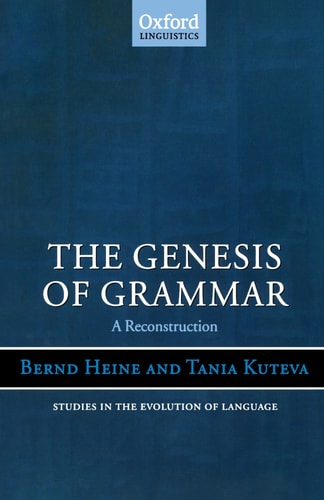
The Genesis of Grammar: A Reconstruction
0
0
As an Amazon Associate and affiliate partner, Menrva Books earns from qualifying purchases. Learn more
Author Description
This book reconstructs what the earliest grammars might have been and shows how they could have led to the languages of modern humankind. Like other biological phenomena, language cannot be fully understood without reference to its evolution, whether proven or hypothesized," wrote Talmy Givón in 2002. As the languages spoken 8,000 years ago were typologically much the same as they are today and as no direct evidence exists for languages before then, evolutionary linguists are at a disadvantage compared to their counterparts in biology. Bernd Heine and Tania Kuteva seek to overcome this obstacle by combining grammaticalization theory, one of the main methods of historical linguistics, with work in animal communication and human evolution. The questions they address include: do the modern languages derive from one ancestral language or from more than one? What was the structure of language like when it first evolved? And how did the properties associated with modern human languages arise, in particular syntax and the recursive use of language structures? The authors proceed on the assumption that if language evolution is the result of language change then the reconstruction of the former can be explored by deploying the processes involved in the latter. Their measured arguments and crystal-clear exposition will appeal to all those interested in the evolution of language, from advanced undergraduates to linguists, cognitive scientists, human biologists, and archaeologists.
Menrva's Summary
THE THESIS
This book investigates the origins of human language by reconstructing the structure of the earliest grammars and identifying the evolutionary processes that led to modern linguistic systems. Bernd Heine and Tania Kuteva, both established scholars in historical linguistics, utilize grammaticalization theory to bridge the gap between modern language structures and prehistoric communication. By applying the principles of language change to evolutionary timelines, the authors argue that the development of syntax and recursion can be modeled through observable linguistic processes, despite the lack of direct evidence for languages spoken prior to 8,000 years ago.
THE SCOPE MAP
What You Will Find
- A theoretical framework connecting grammaticalization theory with human evolution and animal communication.
- Analysis of the transition from proto-language to complex syntax and recursive structures.
- Comparative methodology examining whether modern languages share a single ancestral origin.
Scope Limits
- The study does not provide direct empirical evidence for languages spoken before the 8,000-year historical record.
- The text focuses primarily on linguistic reconstruction rather than the biological or neurological mechanisms of speech production.
THE AUTHORITY PERSPECTIVE
Experts and academics in the field of linguistics recognize this work as a significant contribution to the study of language evolution, particularly for its clear application of grammaticalization theory to deep-time questions. Readers frequently note the academic density of the prose, which is tailored for advanced students and researchers in cognitive science and archaeology.
Page Count:
352
Publication Date:
2007-01-01
Publisher:
Oxford University Press
ISBN-10:
0191527831
ISBN-13:
9780191527838
Evolutionary Linguistics
English
Grammar
Anthropology
Linguistics
English & College Success
Historical linguistics