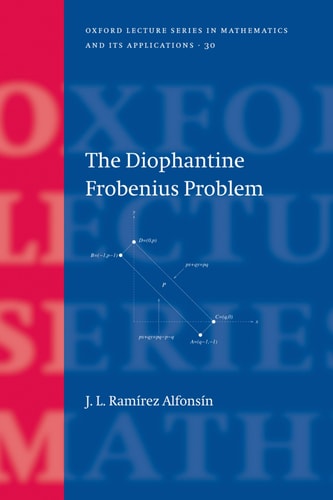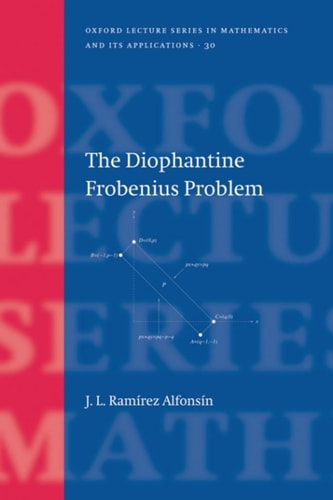
The Diophantine Frobenius Problem
0
0
As an Amazon Associate and affiliate partner, Menrva Books earns from qualifying purchases. Learn more
Author Description
During the early part of the last century, Ferdinand Georg Frobenius (1849-1917) raised he following problem, known as the Frobenius Problem (FP): given relatively prime positive integers a1,...,an, find the largest natural number (called the Frobenius number and denoted by g(a1,...,an) that is not representable as a nonnegative integer combination of a1,...,an,. At first glance FP may look deceptively specialized. Nevertheless it crops up again and again in the most unexpected places and has been extremely useful in investigating many different problems. A number of methods, from several areas of mathematics, have been used in the hope of finding a formula giving the Frobenius number and algorithms to calculate it. The main intention of this book is to highlight such methods, ideas, viewpoints and applications to a broader audience.
Menrva's Summary
THE THESIS
This book investigates the Frobenius Problem, which asks for the largest natural number that cannot be expressed as a non-negative integer combination of a given set of relatively prime positive integers. Jorge L. Ramírez Alfonsín, a specialist in combinatorics and number theory, synthesizes decades of mathematical inquiry to present a comprehensive overview of the problem's history, theoretical significance, and practical utility. The text serves as a bridge between specialized research and a broader mathematical audience by organizing diverse methodologies into a cohesive framework.
THE SCOPE MAP
What You Will Find
- Historical development of the Frobenius Problem from the 19th century to the present
- Analytical methods for calculating the Frobenius number
- Algorithmic approaches and computational complexity analysis
- Applications of the problem in various mathematical subfields
Scope Limits
- The text assumes a foundational understanding of undergraduate-level number theory and algebra
- It does not provide an exhaustive list of every minor variation of the problem published in niche journals
THE AUTHORITY PERSPECTIVE
Experts recognize this volume as a definitive reference for researchers and graduate students interested in the Frobenius Problem. Readers frequently note the technical density of the prose, which effectively captures the complexity of the subject matter while maintaining mathematical rigor.
Page Count:
260
Publication Date:
2005-01-01
Publisher:
OUP Oxford
ISBN-10:
0191524484
ISBN-13:
9780191524486
Post-Calculus
Algorithms
Academic
Combinatorics
Mathematics
Number Theory
Mathematics Statistics