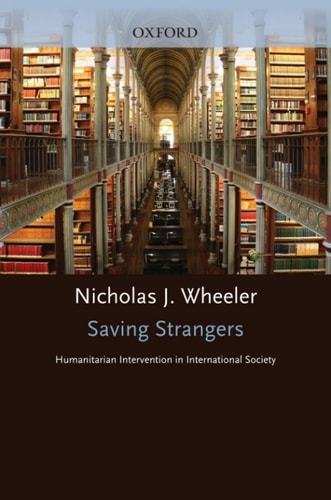
Saving Strangers: Humanitarian Intervention in International Society
0
0
As an Amazon Associate and affiliate partner, Menrva Books earns from qualifying purchases. Learn more
Author Description
The extent to which humanitarian intervention has become a legitimate practice in post-cold war international society is the subject of this book. It maps the changing legitimacy of humanitarian intervention by comparing the international response to cases of humanitarian intervention in the cold war and post-cold war periods. Crucially, the book examines how far international society has recognised humanitarian intervention as a legitimate exception to the rules of sovereignty and non-intervention and non-use of force. While there are studies of each case of intervention-in East Pakistan, Cambodia, Uganda, Iraq, Somalia, Rwanda, Bosnia and Kosovo-there is no single work that examines them comprehensively in a comparative framework. Each chapter tells a story of intervention that weaves together a study of motives, justifications and outcomes. The legitimacy of humanitarian intervention is contested by the 'pluralist' and 'solidarist' wings of the English school, and the book charts the stamp of these conceptions on state practice. Solidarism lacks a full-blown theory of humanitarian intervention and the book supplies one. This theory is employed to assess the humanitarian qualifications of the cases of intervention analysed in the book, and this normative assessment is then compared to the moral practices of states. A key focus is to examine how far humanitarian intervention as a legitimate practice is present in the diplomatic dialogue of states. In exploring how far there has been a change of norm in the society of states in the 1990s, the book defends the broad based constructivist claim that state actions will be constrained if they cannot be legitimated, and that new norms enable new practices but do not determine these. The book concludes by considering how far contemporary practices of humanitarian intervention support a new solidarism, and how far this resolves the traditional conflict between order and justice in international society.
Menrva's Summary
THE THESIS
This book investigates the extent to which humanitarian intervention has evolved into a legitimate practice within international society during the post-Cold War era. Nicholas J. Wheeler, a scholar of international relations, utilizes a constructivist framework to analyze how state actions are constrained by the necessity of moral legitimation. By contrasting the pluralist and solidarist perspectives of the English School, the author develops a theoretical model to evaluate the humanitarian qualifications of various state interventions.
THE SCOPE MAP
What You Will Find
- Comparative analysis of humanitarian interventions in East Pakistan, Cambodia, Uganda, Iraq, Somalia, Rwanda, Bosnia, and Kosovo.
- A theoretical framework for 'solidarism' regarding international intervention.
- Examination of diplomatic dialogues and the evolution of international norms.
Scope Limits
- The text does not provide a comprehensive history of every global conflict, focusing specifically on cases relevant to humanitarian intervention.
- It does not offer a predictive model for future state behavior, focusing instead on normative shifts and past practices.
THE AUTHORITY PERSPECTIVE
Scholars and students of international relations frequently cite this work as a foundational text for understanding the tension between state sovereignty and human rights. Readers often note the academic density of the prose, which provides a rigorous examination of the normative shifts in global politics.
Page Count:
352
Publication Date:
2001-01-01
Publisher:
Oxford University Press
ISBN-10:
0191522597
ISBN-13:
9780191522598
History
Ethics
Diplomacy
International relations
Community Tags
Similar Books