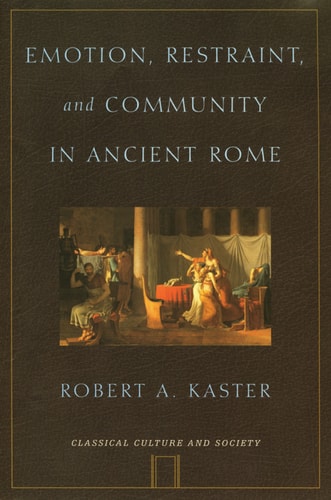
Emotion, Restraint, and Community in Ancient Rome
0
0
As an Amazon Associate and affiliate partner, Menrva Books earns from qualifying purchases. Learn more
Author Description
Classical Culture and Society (Series Editors: Joseph A. Farrell, University of Pennsylvania, and Ian Morris, Stanford University) is a new series from Oxford that emphasizes innovative, imaginative scholarship by leading scholars in the field of ancient culture. Among the topics covered will be the historical and cultural background of Greek and Roman literary texts; the production and reception of cultural artifacts; the economic basis of culture; the history of ideas, values, and concepts; and the relationship between politics and/or social practice and ancient forms of symbolic expression (religion, art, language, and ritual, among others). Interdisciplinary approaches and original, broad-ranging research form the backbone of this series, which will serve classicists as well as appealing to scholars and educated readers in related fields. Emotion, Restraint, and Community examines the ways in which emotions, and talk about emotions, interacted with the ethics of the Roman upper classes in the late Republic and early Empire. By considering how various Roman forms of fear, dismay, indignation, and revulsion created an economy of displeasure that shaped society in constructive ways, the book casts new light both on the Romans and on cross-cultural understanding of emotions.
Menrva's Summary
THE THESIS
This book investigates how the expression and management of specific emotions functioned as a regulatory mechanism for the ethics and social cohesion of the Roman upper classes. Robert A. Kaster, a distinguished classicist, utilizes a combination of literary analysis and historical inquiry to map the Roman 'economy of displeasure.' He argues that emotions such as fear, indignation, and revulsion were not merely private experiences but public tools used to define social boundaries and reinforce communal values during the late Republic and early Empire.
THE SCOPE MAP
What You Will Find
- Analysis of Roman emotional vocabulary and its social application
- Examination of the ethics of the Roman elite during the late Republic and early Empire
- Theoretical framework for an 'economy of displeasure'
Scope Limits
- The study focuses primarily on the upper classes rather than the broader Roman populace
- The analysis is restricted to the late Republic and early Empire periods
THE AUTHORITY PERSPECTIVE
Scholars in the field of classics recognize this work as a significant contribution to the history of emotions and Roman social practice. Experts frequently cite the text for its rigorous methodology and its ability to bridge the gap between literary analysis and cultural history.
Page Count:
256
Publication Date:
2005-01-01
Publisher:
Oxford University Press
ISBN-10:
0190286369
ISBN-13:
9780190286361
History
Upper Class
Ancient - Rome
Ethics
Criticism history
Ethics Ancient
Cultural History
Sociology
Ancient History
Community Tags
Other Editions(2)

Similar Books