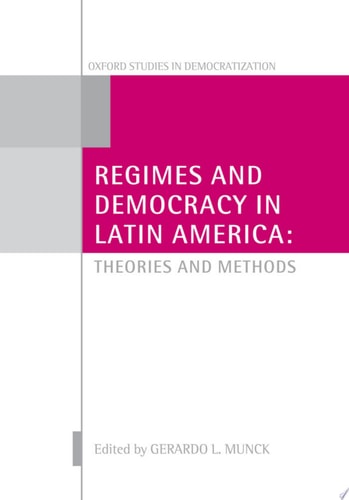
Regimes and Democracy in Latin America: Theories and Methods
0
0
As an Amazon Associate and affiliate partner, Menrva Books earns from qualifying purchases. Learn more
Author Description
This volume focuses on democracy in Latin America, and both assesses the state of current knowledge on the topic and identifies new research frontiers in the study of Latin American politics. It provides an overview of research agendas and strategies used in the literature over the past four decades. It tackles a series of central questions-What is democracy? Is democracy an absolute value? Are current conceptualizations of democracy adequate? How and why does democracy work or fail in Latin America?-and spells out the implications of answers to these questions for current research agendas. It distinguishes between qualitative and quantitative approaches to the conceptualization and measurement of democracy, and presents a dataset on political regimes and democracy that illustrates how the differences between these two standard approaches might be overcome. Finally, it evaluates the strengths and weaknesses of conventional methods used to generate and test explanations of the causes and consequences of democracy, and proposes alternative ways to advance ongoing substantive debates given the current state of theory and data. The contributors are scholars from the United States and Latin America who are experts on Latin America, and who have established reputations as theorists and methodologists. The volume will be of interest to readers seeking to understand debates about democracy in developing societies and to grasp the concepts, theories and methods that are currently being developed to study Latin American politics. Oxford Studies in Democratization is a series for scholars and students of comparative politics and related disciplines. Volumes concentrate on the comparative study of the democratization process that accompanied the decline and termination of the cold war. The geographical focus of the series is primarily Latin America, the Caribbean, Southern and Eastern Europe, and relevant experiences in Africa and Asia. The series editor is Laurence Whitehead,
Menrva's Summary
THE THESIS
This volume investigates the conceptual and methodological challenges inherent in defining, measuring, and explaining the development of democratic regimes within the Latin American context. Gerardo L. Munck, a recognized scholar in comparative politics, synthesizes four decades of research to evaluate how political scientists define democracy and analyze its success or failure. The text provides a critical framework for reconciling qualitative and quantitative approaches to regime classification, ultimately proposing new strategies for future empirical research.
THE SCOPE MAP
What You Will Find
- A comprehensive review of research agendas regarding Latin American political regimes.
- A comparative analysis of qualitative and quantitative measurement methodologies.
- A novel dataset illustrating the integration of diverse analytical approaches.
- Evaluations of causal explanations for democratic stability and collapse.
Scope Limits
- The analysis is geographically constrained to Latin American political systems.
- The text does not provide a general history of Latin American nations, focusing instead on political science theory and methodology.
THE AUTHORITY PERSPECTIVE
Experts identify this work as a foundational text for students and researchers navigating the complexities of comparative democratization studies. Readers frequently note the academic density of the prose, which serves as a rigorous guide for those engaged in advanced political methodology.
Page Count:
286
Publication Date:
2007-01-01
Publisher:
Oxford University Press
ISBN-10:
0191527505
ISBN-13:
9780191527500
American Studies
Latin America
Comparative Politics
Community Tags
Other Editions(2)

Similar Books







Reader Comments
Share Your Thoughts
No comments yet. Be the first to share your thoughts!