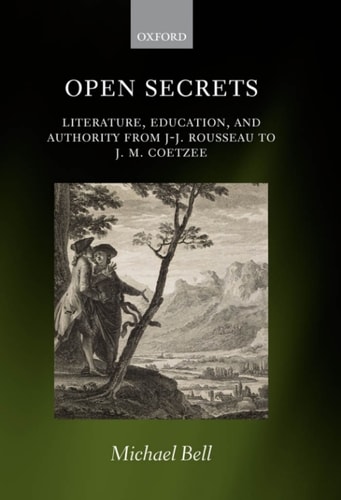
Open Secrets: Literature, Education, and Authority from J. J. Rousseau to J. M. Coetzee
0
0
As an Amazon Associate and affiliate partner, Menrva Books earns from qualifying purchases. Learn more
Author Description
Open Secrets reflects on contemporary humanistic pedagogy by examining the limits of the teachable in this domain. The Goethean motif of the open secret refers not to a revealed mystery but to an utterance that is not understood, the likely fate of any instruction based purely on authority. Revisiting the European Bildungsroman, it studies the pedagogical relationship from the point of view of the tutor or mentor figure rather than with the usual focus on the young hero. The argument is not confined to works of fiction, however, but examines texts in which the category of fiction has a crucial and constitutive function, for a growing awareness of limited authority on the part of the mentor figures is closely related to fictive self-consciousness in the texts. Rousseau's Emile, as a semi-novelised treatise, whose fictiveness is at once overt and yet unmarked, is relatively unaware of the imaginary nature of its envisaged authority. Passing through Laurence Sterne, C. M. Wieland, Goethe and Nietzsche, the situation is gradually reversed, culminating with the conscious impasse of authority in Thus Spoke Zarathustra. All these writers have achieved their pedagogical impact despite, indeed by means of, their internal scepticism. By contrast, in the three subsequent writers, D. H. Lawrence, F. R. Leavis and J. M. Coetzee, the impasse of pedagogical authority becomes more literal as the authority of Bildung is eroded in the wider culture. The awareness of pedagogical authority as a species of fiction, to be conducted in an aesthetic spirit, remains a significant prophylactic against the perennial pressure of reductive conceptions of the education as form of instructional 'production'.
Menrva's Summary
THE THESIS
This work investigates the limits of pedagogical authority by examining the intersection of literature, education, and the inherent fictiveness of the mentor-student relationship. Michael A. Bell, a scholar of literary theory, utilizes a historical survey of European texts to argue that the effectiveness of instruction often relies on an internal skepticism regarding the mentor's own authority. By tracing the evolution of the Bildungsroman and related philosophical treatises, the author demonstrates how the concept of 'open secrets'—utterances that remain misunderstood—defines the boundaries of what can be taught.
THE SCOPE MAP
What You Will Find
- A historical analysis of the pedagogical relationship from the perspective of the mentor figure.
- A study of the transition from the confident instruction in Rousseau's Emile to the skeptical impasse found in Nietzsche's work.
- An examination of the erosion of Bildung in the works of D. H. Lawrence, F. R. Leavis, and J. M. Coetzee.
- A theoretical framework linking fictive self-consciousness to the limitations of educational authority.
Scope Limits
- The text does not provide a practical manual for modern classroom instruction or contemporary pedagogical techniques.
- It does not offer an exhaustive history of education, focusing instead on specific literary and philosophical representations of the mentor-student dynamic.
THE AUTHORITY PERSPECTIVE
Scholars and critics recognize this text as a sophisticated contribution to the intersection of literary theory and the philosophy of education. Readers frequently note the academic density of the prose, which requires a strong background in European literary history to fully navigate the author's arguments.
Page Count:
288
Publication Date:
2007-01-01
Publisher:
Oxford University Press
ISBN-10:
0191525979
ISBN-13:
9780191525971
Philosophy
English
In literature
English & College Success
Literary Criticism
European
Education Theory
Pedagogy
Community Tags
Similar Books